7 Best Propane Patio Heaters (October 2026)
The best propane patio heaters include the Amazon Basics 46 for everyday patio use, the Hykolity 50 for patios needing ballast, and the Hykolity 50 for occasional patio evenings.
On this page (9 sections)
- How we chose these propane patio heaters
- Compare the best propane patio heaters
- Best propane patio heaters for different patios
- How do you choose the best propane patio heater for your space?
- What should you measure before ordering?
- How should you set up a propane patio heater?
- How do you keep warmth useful without wasting fuel?
- What care and mistakes matter most?
- Which best propane patio heater should you choose?
The Amazon Basics 46,000 BTU Propane Patio Heater is the best propane patio heater for most open patios because it combines adjustable warmth, simple controls and practical base-weight features. Choose a table-style model for small-item storage, or FOOWIN when the visible flame is part of the appeal.
Buy for the seating area you actually use, rather than the full size of your yard. A heater beside a compact conversation group has a different job from one expected to serve scattered dining tables.
For a quick overview of fuel and heater styles, start with patio heaters explained. If refills are part of your decision, see how much propane a patio heater uses.
Our picks at a glance
-
1
 Best for everyday patio use
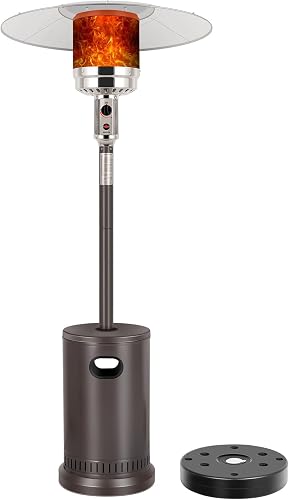
Amazon Basics 46,000 BTU Propane Patio Heater
9.2/10 our score
See it on Amazon -
2
 Best for patios needing ballast
Hykolity 50,000 BTU Sand Box Patio Heater
8.6/10 our score
See it on Amazon -
3
 Best for occasional patio evenings
Hykolity 50,000 BTU Propane Patio Heater
8.1/10 our score
See it on Amazon
- 4
 Check it
EAST OAK 50,000 BTU Patio Heater
Best for outdoor snack breaks - 5
 Check it
FOOWIN 48,000 BTU Patio Heater
Best for flame-focused gatherings - 6
 Check it
Sweetcrispy 48,000 BTU Patio Heater
Best for casual lounge seating - 7
 Best for anchor-friendly outdoor spacesCheck it
How we chose these propane patio heaters
We prioritized useful controls, manageable placement and practical stability features, then considered burner construction, storage and design. The order reflects how well each heater fits common patio needs, rather than output alone.
All 7 options have wheels, so mobility by itself does little to separate them. Adjustable base weight, battery-free ignition, an included cover and convenient valve access are more useful differences.
Coverage figures need care because the brands describe them in different ways. We use those figures as planning clues, not promises that everyone within a circle will feel equally warm.
Compare the best propane patio heaters
Start with shape, base support and convenience, then compare heat output. Most of these heaters sit close together in output, so a suitable location and furniture layout can matter more than a small numerical difference.
The comparison below keeps the main figures together. Read each write-up for the buyer it suits and the reason to choose something else.
| Product | Best for | Heat output | Claimed coverage | Base support | Our score |
|---|---|---|---|---|---|
| Amazon Basics 46,000 BTU Propane Patio Heater | everyday patio use | 46,000 BTU | Up to 9 ft radius, according to Amazon Basics | Water box for added weight | 9.2 |
| Hykolity 50,000 BTU Sand Box Patio Heater | patios needing ballast | 50,000 BTU | Up to 200 sq ft, according to Hykolity | Weight-adjustable water tank | 8.6 |
| Hykolity 50,000 BTU Propane Patio Heater | occasional patio evenings | 50,000 BTU | Up to 200 sq ft, according to Hykolity | 8.1 | |
| EAST OAK 50,000 BTU Patio Heater | outdoor snack breaks | 50,000 BTU | Up to 20 ft diameter, according to EAST OAK | Weight-adjustable water tank | 8.0 |
| FOOWIN 48,000 BTU Patio Heater | flame-focused gatherings | 48,000 BTU | 130 sq ft, according to FOOWIN | 7.9 | |
| Sweetcrispy 48,000 BTU Patio Heater | casual lounge seating | 48,000 BTU | 18 ft diameter, according to Sweetcrispy | Ground anchors included | 7.4 |
| DUMOS 48,000 BTU Patio Heater | anchor-friendly outdoor spaces | 48,000 BTU | 18 ft diameter, according to DUMOS | Anchoring spikes included | 7.0 |
Best propane patio heaters for different patios
Choose Amazon Basics for general patio use, a table-style heater for extra convenience, or FOOWIN for a visible flame. The right match also depends on how often you will move it and where it will live between uses.
Amazon Basics 46,000 BTU Propane Patio Heater
- 46,000 BTU heat output
- Adjustable heat control
- Water box for base weight
- Wheels and tilt shut-off
A practical first choice for an open patio where you want adjustable warmth and a heater you can roll into position. A tank chain and water box help with setup.
Pros
- One-touch ignition
- Adjustable output
- Water box and tank chain included
Cons
- 20 lb propane tank sold separately
- Tall design needs substantial overhead space
Amazon Basics is the clearest starting point for a household that wants warmth beside a dining or conversation area. Its 46,000 BTU output adjusts with a knob, and Amazon Basics claims reach up to a 9-foot radius.
The one-touch ignition keeps startup straightforward. A water box adds base weight, while the included chain secures the propane cylinder inside the housing.
That combination suits a heater you position before an evening outdoors, then return to storage once it is shut down and cool. Use the wheels on a clear route rather than expecting them to handle steps or loose ground easily.
You'll need a separate 20 lb propane tank. Allow for that cylinder, a refill routine and a place to store it safely when planning the whole setup.
Skip this model if your main goal is a built-in table or a flame display. At 91.3 inches tall, it also needs a suitable overhead area with the full additional clearance its manual requires.
Hykolity 50,000 BTU Sand Box Patio Heater
- 50,000 BTU heat output
- Table design
- Weight-adjustable water tank
- Double-layer 304 stainless steel burner mesh
Choose this Hykolity when adjustable base weight and a small table surface suit your patio. Its broad upper profile needs room around furniture and walkways.
Pros
- Adjustable base ballast
- One-press ignition
- Tilt protection and wheels
Cons
- 33.6-inch overall width needs room
- Ballast does not make it suitable for strong winds
The Hykolity Sand Box model suits a patio where adjustable ballast is a buying priority. Despite the model name, its supplied base-weight feature is a water tank, so follow the manual's filling instructions rather than assuming any ballast material will do.
Its conical housing and table design make it a useful alternative for buyers who want more than a plain tank enclosure. The double-layer 304 stainless steel burner mesh is another concrete construction feature to compare.
Hykolity gives a maximum output of 50,000 BTU and claims coverage up to 200 sq ft. The control valve lets you reduce the output when nearby seats need less heat.
Tilt protection extinguishes the flame beyond 45 degrees, but it cannot prevent the heater from falling or striking furniture.
Choose this model if you have room for its 33.6-inch overall width and want to add base weight as directed. Skip it for a narrow passage or an exposed location where you expect ballast to solve strong-wind problems.
Hykolity 50,000 BTU Propane Patio Heater
- 50,000 BTU heat output
- Battery-free piezoelectric ignition
- Adjustable heat
- Cover included
Battery-free ignition and an included cover suit occasional use with storage between sessions. Wheels and adjustable output cover the everyday controls.
Pros
- No ignition battery to replace
- Cover included
- Wheels for repositioning
Cons
- Verify assembled size before planning storage
- Needs a suitable open outdoor location
This Hykolity suits occasional patio use when you want battery-free piezoelectric ignition and a cover included from the start. There is no ignition battery to keep ready between infrequent evenings outdoors.
Adjustable output helps you tune the warmth as conditions change. The table design and wheels add everyday convenience without requiring you to choose the separate Sand Box model.
Hykolity claims coverage up to 200 sq ft, but furniture spacing and weather still shape how useful that area feels. Plan around your occupied seats rather than treating the whole claimed area as equally comfortable.
Confirm the assembled dimensions before reserving a storage spot, especially if you must pass through a gate.
Skip it if adjustable water ballast is your main reason for choosing a heater. Use it outdoors only, and review our guide to patio heater clearance from a covered patio ceiling if your intended location has a roof.
EAST OAK 50,000 BTU Patio Heater
- 50,000 BTU heat output
- Round stainless steel tabletop
- Accessible gas valve opening
- Weight-adjustable water tank
The round tabletop and valve-access opening suit relaxed gatherings where convenience matters. Choose it for the layout features rather than its coverage claim alone.
Pros
- Surface for small items
- Gas valve access without lifting housing
- Adjustable heat and one-touch ignition
Cons
- EAST OAK advises against use in rain or storms
- Table placement must respect heat exposure
EAST OAK suits buyers who want a usable round tabletop and easy gas-valve access. The opening in the housing lets you close the valve without lifting the tank enclosure.
That access matters when you want a clear shutdown routine at the end of an evening. Keep the opening reachable rather than placing the heater where a chair or planter blocks it.
EAST OAK claims a heating area up to 20 feet in diameter. Its adjustable control lets you manage output, while the water tank provides an option for adding base weight.
Use the table only as the instructions allow, since nearby objects can be damaged by radiant heat. It is a small convenience surface, not a reason to move chairs closer than permitted.
Skip this model if your plan depends on using it through wet weather. EAST OAK advises against operation in rain or storms; our EAST OAK patio heater review explores its features further.
FOOWIN 48,000 BTU Patio Heater
- 48,000 BTU heat output
- Pyramid design with quartz glass tube
- Waterproof cover and gloves included
- Wheels and tilt shut-off
The visible flame makes FOOWIN the style-led choice for an outdoor gathering area. Its weight and glass tube call for a clear storage route and careful handling.
Pros
- Visible flame through quartz glass
- Cover included
- Adjustable heat control
Cons
- Heavier to move across awkward surfaces
- Glass tube needs protection from impacts
FOOWIN is the choice for buyers who want the heater to contribute a visible flame to the evening. Its pyramid frame surrounds a quartz glass tube, giving it a different role from the overhead-reflector designs.
Choose it for a gathering spot where people can enjoy that appearance without crowding the heater. FOOWIN claims 130 sq ft of coverage, so do not assume its flame display means broader warmth.
The package includes a waterproof cover and operating gloves. Neither changes the need to let the heater cool fully before covering or handling parts that become hot.
At 50.7 lb, it deserves a realistic moving plan. Wheels help on a suitable surface, but a step, gravel path or tight turn can still make regular storage awkward.
Skip it if warmth is your only priority or you expect to move it over obstacles often. Protect the glass tube from impacts, and leave a clear route around the heater so guests do not brush past it.
Sweetcrispy 48,000 BTU Patio Heater
- 48,000 BTU heat output
- Round side table
- Double-layer 304 stainless steel burner
- Tilt and flame-out shut-off
A round side table suits a lounge area with limited space for separate small tables. Check the seating clearances and whether the included anchors suit your ground.
Pros
- Tabletop with valve-access cutout
- Flame-out and tilt shut-off
- Wheels and ground anchors
Cons
- Anchors need compatible ground
- Tabletop must stay within permitted use
Sweetcrispy suits a lounge area where a round side table would be useful beside the heater. It can reduce the need for a separate small surface, provided your seating still meets the required clearances.
The tabletop has a central cutout for valve access. Keep that opening clear so shutting off the cylinder stays simple.
Its burner uses double-layer 304 stainless steel mesh. Sweetcrispy claims an 18-foot diameter heating area, but the number of comfortable seats depends on their spacing and outdoor conditions.
Flame-out protection cuts the gas if the flame goes out, and tilt protection shuts the heater off beyond 45 degrees. These are useful backup features, not permission to leave an operating heater unattended.
Choose it when the table layout suits your furniture and the included ground anchors suit an approved location. Skip it if you need a ballast system for hard paving or would have to crowd chairs around the base to reach the tabletop.
DUMOS 48,000 BTU Patio Heater
- 48,000 BTU heat output
- Round tabletop
- Wheels and anchoring spikes
- Tilt and flame-out shut-off
DUMOS suits an approved outdoor location where its included spikes can be used properly. A tabletop and gas-valve opening add convenience during gatherings.
Pros
- Anchoring spikes included
- Accessible gas valve opening
- Double-layer 304 stainless steel burner mesh
Cons
- Spikes are not a ready solution for hard paving
- Anchoring does not replace a level supporting surface
DUMOS suits buyers with an approved placement area where anchoring spikes can be installed as directed. Think through that ground connection before choosing it for a paved patio or deck.
The heater combines a round table with a valve-access opening. Those features make sense for a gathering area where you want a small surface and a clear way to shut off the fuel.
DUMOS claims an 18-foot diameter heating area and describes use around groups of 4 to 8 people. Treat the group size as a suggested use, since chair spacing and required clearances determine your actual layout.
Its double-layer 304 stainless steel burner mesh and flame-out and tilt shut-offs cover useful construction and control details.
Choose DUMOS when the anchoring method fits your location without changes to the heater. Skip it if the ground slopes, the spikes cannot be secured properly, or you would need an improvised attachment to keep the unit upright.
How do you choose the best propane patio heater for your space?
Choose by placement first, seating layout second and convenience third. A heater that cannot meet its manual's clearances is the wrong purchase, regardless of its output or accessories.
Match the best propane patio heater to your seating
Start with the chairs people use most and identify a heater position that serves them without blocking movement. Measure with chairs pulled out, since a dining setup needs more room during use than when tucked away.
A single compact group is easier to plan around than seats spread across opposite ends of a patio. If your layout has separate zones, prioritize one area rather than buying around a promise to warm everything.
Leave a walking route that does not pass tightly beside the burner, reflector or tank housing. Also consider where children, pets and guests naturally move when entering or leaving the seating area.
Read radius, diameter and area correctly
A 9-foot radius describes an 18-foot diameter circle, while square footage describes area. Those numbers are different ways of expressing space, so comparing the largest printed number can lead you astray.
Even correctly converted figures do not establish equal comfort across brands. Breeze, air temperature, heater shape and distance from the burner all affect what reaches a seated person.
Treat claimed reach as an outer planning guide and keep your main seats in a sensible nearby zone while respecting all clearances. Do not place someone at the claimed limit and expect the same warmth as a closer seat.
Keep small output differences in perspective
The heaters here range from 46,000 to 50,000 BTU, a fairly narrow spread. Maximum output matters, but it does not settle which model fits your patio best.
An easy-to-reach control, suitable ballast and a workable storage route may be more valuable than the extra output. Adjustable heat also lets you respond when the evening cools or nearby guests prefer less warmth.
Avoid choosing solely by burner material, too. Stainless steel construction is useful to compare, but it does not establish a specific service life or remove the need for care.
Decide whether propane fits your routine
Propane suits an open outdoor spot where you want heat without an outlet or permanent installation. You must be willing to manage cylinders, fuel connections and a refill schedule.
For frequent short sessions, cylinder handling may feel like more work than you want. Our propane vs electric patio heater comparison helps you weigh that routine before committing to a fuel type.
What should you measure before ordering?
Measure the complete operating space and storage route, not just the base. Reflectors and tabletops can extend beyond the housing, and combustible clearances add space around the heater itself.
Check overhead and side clearances separately
Overall height tells you whether the heater physically fits, not whether it can operate there. The manual's required space above and beside hot parts is additional.
Look for roof beams, umbrella fabric, branches, siding and other materials near the intended position. Furniture cushions and objects stored beside the heater also need to stay outside the required clearance zones.
A cover overhead needs its own placement decision. Do not assume that a tall roof or several open sides makes a propane heater suitable underneath it.
Plan the trip from storage
Measure gates, turns and the narrowest part of the route with the heater's widest assembled part in mind. Check whether you can move it without catching the reflector on a doorway or branch.
Wheels work best on firm, clear surfaces. If your route includes steps, do not plan to drag or lift a bulky assembled heater alone.
Decide where the cooled heater will stand between uses. Storage should protect it from damage without creating an unsafe location for a connected or spare propane cylinder.
How should you set up a propane patio heater?
Set it up on firm, level ground in a permitted outdoor location, following the exact model's manual. Finish assembly and fuel checks before inviting people into the seating area.
Assemble and stabilize before connecting fuel
Check that the reflector, post, burner and base are secure, using the supplied instructions for fasteners and assembly order. A loose upper section can create problems even when the base feels heavy.
Fill a water ballast container only as directed. If freezing weather is possible, follow the manual's storage instructions so retained water does not damage the container.
Use anchors only with a suitable surface and the approved method. They do not turn sloped ground into a level platform or make strong-wind operation safe.
For more placement help, read how to keep a patio heater from tipping over.
Check the fuel connection before lighting
Use the cylinder type and connection specified for your heater, and inspect the hose and regulator for visible damage. Route the hose so it cannot be pinched by the housing.
Perform the manual's leak check with the approved leak-detection solution, never a flame. If you smell gas or find a leak, do not light the heater; shut off the supply if safe and resolve the fault first.
Keep the cylinder upright and secure it using the heater's intended restraint. Do not improvise adapters or modify the fuel system to fit a cylinder it was not designed to use.
Learn ignition and shutdown before the first evening
Read the lighting sequence while the heater is off, including how long to hold a control and what to do after a failed attempt. Repeatedly pressing ignition without following the reset procedure is a poor substitute for the instructions.
Our guide to how to light a patio heater explains the general process. Your model's manual controls the exact sequence.
At shutdown, follow the prescribed control and cylinder-valve steps. Let the unit cool completely before moving it or putting on a cover.
How do you keep warmth useful without wasting fuel?
Use the lowest comfortable setting for the seats you occupy. Running at maximum output all evening consumes fuel faster and may add little comfort if warmth is being carried away by wind.
Arrange the seating before lighting, and make any heater moves while it is off and cool. Guests should not pull the heater closer or move chairs inside the required clearances to chase warmth.
Plan for the length of the gathering rather than assuming a cylinder will last because it did on a previous evening. A different setting or a partly filled tank changes that calculation.
If wind makes the heater ineffective or unstable, shut it down according to the instructions. Do not surround it with screens, blankets or makeshift walls to trap heat.
What care and mistakes matter most?
Keep the heater clean, dry and mechanically secure, and avoid using safety features as a reason to relax placement rules. A few simple habits prevent common setup and storage problems.
Cover only after the heater cools
Remove the cover fully before use, then wait for complete cooling before replacing it. A waterproof cover protects a stored heater; it does not permit operation underneath the cover or in unsuitable weather.
Check periodically for trapped moisture rather than assuming a covered heater stays dry. Follow the manual for cleaning the finish, reflector and other surfaces.
Keep burner openings clear
Inspect accessible air openings for debris, insects and cobwebs as the manual directs, especially after storage. Restricted openings can interfere with proper operation.
Do not poke tools into burner parts or enlarge openings. Stop using the heater if it behaves abnormally, and follow the troubleshooting instructions or arrange service.
Do not confuse shut-off protection with stability
A tilt switch responds after the heater leans far enough; it does not hold the unit upright. Flame-out protection also does not remove the need for leak checks and correct connections.
Check fasteners and support points after moving the heater. Never bypass a safety device to keep a reluctant burner running.
Keep tabletop use modest and within the manual's limits. Do not drape towels over the heater, hang items from it or let bags and cushions collect beside its base.
Which best propane patio heater should you choose?
Choose the Amazon Basics heater for a straightforward open-patio setup, or the Hykolity Sand Box model when adjustable ballast is a priority. Pick the other Hykolity for battery-free ignition and an included cover, and EAST OAK for convenient tabletop and valve access.
Choose FOOWIN when the flame display matters enough to accept its handling needs. Sweetcrispy and DUMOS make sense when their table layouts and supplied anchoring options fit your location.
The best propane patio heater is the one you can place correctly, store conveniently and fuel without a last-minute scramble. Before your first long gathering, plan refills with our guide to how long a propane tank lasts on a patio heater.
Our top 3 picks at a glance
-
1
Best for everyday patio use
Amazon Basics 46,000 BTU Propane Patio Heater
9.2/10 our score
See it on Amazon -
2
Best for patios needing ballast
Hykolity 50,000 BTU Sand Box Patio Heater
8.6/10 our score
See it on Amazon -
3
Best for occasional patio evenings
Hykolity 50,000 BTU Propane Patio Heater
8.1/10 our score
See it on Amazon
Frequently asked questions
What is the best propane patio heater for most people?
The Amazon Basics 46,000 BTU Propane Patio Heater is our first choice for most open patios because its adjustable heat, wheels and water box cover common needs. Choose a table-style alternative if you need a small surface beside the heater, and check every model's required clearances before ordering.
Are propane patio heaters safe to use under a covered patio?
Use a propane patio heater under a cover only when its manual permits that placement and every ventilation and clearance requirement can be met. A roof height or open side alone does not prove suitability.
Our covered patio heater safety guide explains the placement questions to resolve before use.
How long does a propane tank last on a patio heater?
Tank life depends on usable fuel and the heater's output setting, so there is no single runtime for every evening. Higher output consumes fuel faster, while a partly filled cylinder shortens the session.
Use our guide to how long a propane tank lasts on a patio heater to plan refills.
Can you use a propane patio heater indoors?
No, these propane patio heaters belong outdoors and must stay out of homes, garages, tents and other enclosed spaces. Burning propane creates exhaust, and ventilation and combustible clearances still matter outside.
Read why patio heaters should not be used indoors before choosing a location near walls, doors or a roof.