6 Best Outdoor Heaters for Decks (October 2026)
The best outdoor heaters for decks include the Amazon Basics 46 for everyday deck seating, the Hykolity 50 for roomy conversation areas, and the Hykolity 50 for occasional evening use.
On this page (8 sections)
- Which outdoor heater for a deck fits your layout?
- The best outdoor heaters for decks
- How should you choose an outdoor heater for your deck?
- Can a propane heater go on wood, composite or a covered deck?
- How do you set up a deck heater for the first evening?
- What care keeps a deck heater ready to use?
- Which buying mistakes should you avoid?
- Which outdoor heater for a deck should you pick?
The Amazon Basics 46,000 BTU Propane Patio Heater is our top outdoor heater for a deck with an approved open-air setup. Its adjustable heat, water-weighted base and wheels cover the main needs of a regular seating area.
Choose the Hykolity Sand Box for a roomy conversation space, FOOWIN for a visible flame, or Sweetcrispy when a built-in drinks table would be useful. A small deck or low cover may call for a different heater type.
Plan around occupied seats, not the deck's total square footage. A heater beside the chairs you use can be more useful than a higher-output model stranded away from everyone to meet its clearances.
These picks are all propane models, so fuel storage and tank access are part of the decision. None should be chosen for an enclosed porch or indoor room.
For a broader look at fuel types and shapes, start with our guide to propane, electric and infrared patio heaters. To compare other models using the same fuel, see our best propane patio heaters.
Our picks at a glance
-
1
 Best for everyday deck seating
Amazon Basics 46,000 BTU Propane Patio Heater
9.2/10 our score
See it on Amazon -
2
 Best for roomy conversation areas
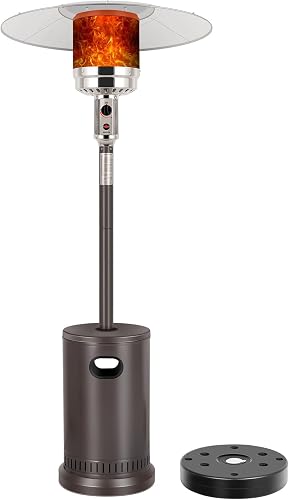
Hykolity 50,000 BTU Sand Box Patio Heater
8.6/10 our score
See it on Amazon -
3
 Best for occasional evening use
Hykolity 50,000 BTU Propane Patio Heater
8.1/10 our score
See it on Amazon
- 4
 Check it
FOOWIN 48,000 BTU Patio Heater
Best for evening atmosphere - 5
 Check it
Sweetcrispy 48,000 BTU Patio Heater
Best for drinks beside seating - 6
 Check it
NEWBULIG 48,000 BTU Patio Heater
Best for deck-and-lawn households
Which outdoor heater for a deck fits your layout?
Amazon Basics is the strongest starting point for regular deck seating, while the other picks solve more specific needs. Choose by the space around your chairs, the heater's approved setup and how often you'll move it.
A table design helps beside lounge chairs, but it can crowd a narrow dining layout. A slim pyramid can leave more visible floor space while still needing a wide clear zone around hot parts.
We compared heat controls, overall dimensions, base weighting, fuel access and features that affect daily use. Coverage claims help narrow the choice, but wind and seating distance matter more than small differences in maximum output.
| Product | Best for | Heat output | Fuel | Dimensions | Our score |
|---|---|---|---|---|---|
| Amazon Basics 46,000 BTU Propane Patio Heater | everyday deck seating | 46,000 BTU | Propane, 20 lb tank not included | 32.1 x 32.1 x 91.3 in | 9.2 |
| Hykolity 50,000 BTU Sand Box Patio Heater | roomy conversation areas | 50,000 BTU | Propane | 33.6 x 33.6 x 86.4 in | 8.6 |
| Hykolity 50,000 BTU Propane Patio Heater | occasional evening use | 50,000 BTU | Propane | 8.1 | |
| FOOWIN 48,000 BTU Patio Heater | evening atmosphere | 48,000 BTU | Propane | 18.11 x 20.4 x 81.4 in | 7.9 |
| Sweetcrispy 48,000 BTU Patio Heater | drinks beside seating | 48,000 BTU | Propane | 32.1 x 32.1 x 87 in | 7.4 |
| NEWBULIG 48,000 BTU Patio Heater | deck-and-lawn households | 48,000 BTU | Propane, 20 lb tank excluded | 18.1 x 18.1 x 87 in | 6.9 |
The best outdoor heaters for decks
Start with the highest-ranked model that fits your deck's approved operating space. A lower-ranked heater makes sense when its shape or convenience features solve a specific problem in your layout.
Amazon Basics 46,000 BTU Propane Patio Heater
- 46,000 BTU output
- Adjustable heat control
- Wheels
- Water box for base weight
Adjustable heat and a water box for base weight make this a practical choice for a regular seating area. Allow room for its broad upper section and separate propane tank.
Pros
- Adjustable heat output
- Wheels for moving when cool
- Water box for base weight
- Chain included to secure the tank
Cons
- Separate 20 lb propane tank required
- Tall profile needs generous overhead space
The Amazon Basics heater suits people who use the same outdoor seating area often and want to adjust the warmth as the evening cools. Its control knob lets you reduce output without moving the heater closer to furniture.
The water box gives you a built-in way to add base weight. A tilt safety shutoff valve adds protection, while the included chain secures the propane tank inside the unit.
Its overall dimensions are 32.1 x 32.1 x 91.3 in. Measure the full width and overhead space rather than assuming the smaller-looking base defines everything that must fit.
Amazon Basics claims warmth within a 9 ft radius. Think of that as a planning guide for nearby seats, with comfort dropping as people sit farther away or wind crosses the deck.
Choose this model if you have a regular operating spot and a clear route for rolling it into storage when cool. Skip it if stairs, a narrow door or crowded furniture would make each storage move difficult.
Budget for a separate 20 lb propane tank and plan where you'll refill or exchange it. Buying the heater before solving tank storage leaves an avoidable job for the first cool evening.
Hykolity 50,000 BTU Sand Box Patio Heater
- 50,000 BTU output
- Table design
- Double-layer stainless steel burner mesh
- Weight-adjustable water tank
The table design suits a spacious seating group, while the adjustable water tank provides a way to add base weight. Its broad dimensions make it a poor match for a tight deck.
Pros
- Table design beside seating
- Weight-adjustable water tank
- Wheels
- Double-layer 304 stainless steel burner mesh
Cons
- Wide overall dimensions need planning
- Added base weight makes storage moves less convenient
The Hykolity Sand Box heater suits a spacious conversation area where its table design can sit beside chairs without blocking access. Its weight-adjustable water tank is useful when you want a built-in base-weighting option.
Despite the Sand Box name, this model includes a water tank for adding weight. Follow the filling instructions for the exact model rather than choosing ballast based on its name.
The burner uses double-layer 304 stainless steel mesh, and heat is adjustable through the control valve. Hykolity claims coverage up to 200 sq. ft., though a long row of seats will not feel the same as a compact seating group.
Its 33.6 x 33.6 in overall width and depth make it a poor choice for tight corners. Mark that outline on the deck and pull the nearby chairs out before deciding it fits.
Choose it when a table feature and weighted base both serve your layout. Skip it if you already have plenty of side tables or need to roll the heater across thresholds after every use.
The extra maximum output over our top pick should not decide the purchase. A better position beside the seats you use is more valuable than a small increase in burner capacity.
Hykolity 50,000 BTU Propane Patio Heater
- 50,000 BTU output
- Wheels
- Adjustable temperature
- Battery-free piezoelectric ignition
Battery-free ignition and an included cover suit a heater brought out for occasional gatherings. Confirm its assembled dimensions before planning a permanent spot.
Pros
- Ignition needs no battery
- Adjustable heat
- Wheels
- Cover included
Cons
- Assembled dimensions need confirmation
- Propane storage and refills still required
The second Hykolity heater suits occasional evening use when you want simple ignition and a cover included from the start. Its piezoelectric ignition needs no battery, so there's no ignition battery to replace between seasons.
Adjustable heat lets you change output as guests settle in or the temperature falls. Wheels help with storage moves, provided the route is level enough and the heater is off and cool.
Confirm the assembled height and width before ordering. The supplied dimensions do not give a dependable basis for planning a tall heater's operating space, which matters beside doors, railings and overhead structures.
Choose this model if you can resolve those measurements and want the combination of battery-free ignition and an included cover. Skip it if you need to finalize a tight layout without further size checks.
Hykolity describes weather-resistant features, but storage and routine care still matter. A cover is useful between sessions; it does not mean the heater should stay exposed through every storm.
Keep this heater outdoors even though some promotional wording mentions indoor use. A portable propane patio heater belongs in an approved outdoor setting with the ventilation its manual requires.
FOOWIN 48,000 BTU Patio Heater
- 48,000 BTU output
- Pyramid shape with quartz glass tube
- Wheels
- Waterproof cover included
Choose FOOWIN for a visible flame and pyramid shape beside an open seating area. Its narrower dimensions help with layout planning, but operating clearances still determine the space it needs.
Pros
- Visible flame in a quartz glass tube
- Narrower overall dimensions than several picks
- Wheels
- Cover and operating gloves included
Cons
- Coverage figures are inconsistent
- Glass tube adds a part to inspect and protect
The FOOWIN heater suits people who want a visible flame as part of the deck's evening atmosphere. Its pyramid shape and quartz glass tube give it a different look from the broad-topped standing models.
At 18.11 x 20.4 x 81.4 in, it has narrower overall dimensions than several picks here. That helps with layout planning, though it does not reduce the required distance from furniture or combustible materials.
FOOWIN gives both a 130 sq. ft. coverage claim and a separate 10 ft figure without a clear radius or diameter. Use seating distance and the approved operating position to judge fit instead of treating those figures as equal measurements.
Choose it for a compact seating group where the flame remains visible without placing the heater in a walking route. Skip it if maximum warmth across a broad dining arrangement matters more than appearance.
The heater weighs 50.7 lb, so wheels do not make it a convenient choice for frequent trips over steps. Plan a nearby storage location before assembly.
A waterproof cover and operating gloves are included. Let the heater cool fully before covering it, and include the glass tube in your pre-use inspection for visible damage.
Sweetcrispy 48,000 BTU Patio Heater
- 48,000 BTU output
- Built-in round side table
- Wheels
- Tilt and flame-out protection
The round side table adds a place for drinks and small essentials near lounge seating. Choose it for that convenience, and confirm an approved stability method for your deck.
Pros
- Built-in round side table
- Valve access through the table cutout
- Wheels
- Tilt and flame-out protection
Cons
- Broad overall dimensions
- Included ground anchors do not establish a deck fastening method
The Sweetcrispy heater suits lounge seating where a built-in round table can hold a drink or small essentials. The central cutout gives access for valve adjustments, so the table has a practical role beyond appearance.
Choose it when that surface can replace a separate side table. If it would simply add another object beside an already crowded sofa, a simpler heater layout makes more sense.
Sweetcrispy claims an 18 ft diameter heating area. Keep the chairs you use most within a compact group rather than spreading them across that full span and expecting equal comfort.
The heater includes both tilt and flame-out protection. Those systems address specific faults; they do not remove the need to keep children, pets and loose clothing away from hot surfaces.
Ground anchors are included, but they do not establish an approved fastening method for deck boards. Resolve deck stability through the manual before treating the anchors as a reason to buy.
Skip this model if guests would need to reach across the heater to collect drinks. Place it so the table is easy to approach from the seating side, while keeping the controls and tank access clear.
NEWBULIG 48,000 BTU Patio Heater
- 48,000 BTU output
- Wheels
- Soft-ground anchors
- Tip-over and flame-out protection
The soft-ground anchors may help households with a separate lawn location as well as a deck. For deck use, confirm an approved setup that does not depend on driving those anchors into boards.
Pros
- Anchors supplied for lawns and soft ground
- Wheels
- Tank-position viewing cutout
- Tilt and flame-out protection
Cons
- Soft-ground anchors are not a deck solution
- Separate 20 lb propane tank required
The NEWBULIG heater is most relevant to households with both a deck and a separate lawn gathering area. Its included anchors are intended for soft ground, giving them a use beyond a deck setting.
For deck use, confirm a suitable setup independent of those anchors. They are not for hard concrete, and their inclusion does not give permission to drive them into wood or composite boards.
The side cutout allows a visual check of tank position, while wheels help with repositioning between approved locations. Tip-over and flame-out protection are included.
Its narrower dimensions may appeal on a crowded deck, but a narrow body cannot solve inadequate clearances. Check the space around the hot upper section as carefully as the ground-level area.
Choose NEWBULIG if the soft-ground anchors will serve a real second location and its deck setup is approved. Skip it if deck use is your only goal and you still have unanswered questions about keeping it stable.
It requires a separate standard 20 lb propane tank. Plan the storage route around the assembled heater and tank-handling instructions, especially if the lawn is reached by stairs or uneven ground.
How should you choose an outdoor heater for your deck?
Choose the operating location before the heater. Once you know the available space, surface requirements and fuel access, the useful options become much easier to separate.
What footprint fits an outdoor heater for your deck?
Measure the whole assembled heater and its clearance zone, not just the base touching the boards. A broad reflector can extend well beyond the cabinet below it.
Mark the proposed outline with removable tape while the heater is absent. Then pull out dining chairs, open the door fully and walk the usual route carrying a tray.
Allow separate access for changing the tank and reaching the controls. A heater that fits only when every chair is pushed in does not fit the way you'll use the deck.
Long, narrow decks are especially difficult because the heater can divide the walking route. If no freestanding position works, reconsider the heater type rather than squeezing a tower beside the railing.
How much warmth should you expect?
Size the heater around a seating group, not an empty deck boundary. Outdoor heaters add local comfort; they do not hold an entire open deck at a set room temperature.
These models range from 46,000 to 50,000 BTU. That small spread is less useful for choosing than the distance between the heater and each chair.
A radius measures outward from the heater, while a diameter measures across the full circle. Square-foot claims describe area, so those numbers should not be compared as though they use the same scale.
Wind also changes comfort by carrying warmed air away and cooling exposed skin. If your deck is regularly gusty, a larger burner will not solve the placement problem.
Which heater shape suits your seats?
Choose a shape that leaves the heat source useful and the walking route clear. A broad-topped standing heater is a practical starting point for a nearby seating group; a visible-flame pyramid adds atmosphere.
For dining, consider where people sit after chairs are pulled away from the table. One heater at the far end may leave the opposite end feeling cool.
For lounge seating, a side-table design can reduce furniture clutter. Keep the table reachable without encouraging guests to crowd the hot upper section.
An L-shaped sofa can leave seats at very different distances from a single heater. Plan around the occupied corner rather than placing the heater at the deck's visual center.
Is propane the right fuel for your deck?
Propane suits an approved open-air location where you want heat without an electrical cord. It also brings tank changes, fuel storage and connection checks.
Electric can suit a fixed seating area if a suitable outdoor supply and approved mounting position are available. Check the heater's electrical requirements before assuming a nearby outlet is enough.
If tank handling would discourage you from using the heater, compare electric patio heaters with propane models. For more choices using propane, browse the propane heater guide.
Can a propane heater go on wood, composite or a covered deck?
Use a propane heater only where its manual permits the surface and arrangement. Wood boards, composite decking, roofs and nearby screens each add placement questions that burner output cannot answer.
Check the surface before adding accessories
Confirm the heater's floor requirements and your decking manufacturer's heat guidance. A flat-looking spot can still have loose boards, rocking furniture or drainage gaps that affect stable placement.
Do not assume a mat, tile or paving slab makes an unsuitable surface acceptable. Added layers can change stability, trap moisture or conflict with the required setup.
Use only an approved weighting or securing method. Improvised straps to a railing can create a new problem if they pull the heater sideways or attach it to combustible material.
Resolve overhead clearance before buying
A covered deck needs explicit approval for the arrangement, plus enough ventilation and clearance. An open side does not cancel the risks posed by a low roof, awning or hanging fabric.
Measure from the parts named in the manual, including the hot upper section. Account for umbrellas, string lights, plants and retractable shades in the position they occupy during use.
Our guide to outdoor heaters for covered patios explains the questions to resolve. If the required space is unavailable, choose another approved heating arrangement.
Treat wind as an operating limit
Base weight helps stability, but it does not make a heater suitable for every wind condition. Follow the model's wind guidance and stop using it when conditions make it unstable or disrupt the flame.
Never block ventilation with temporary screens or blankets to preserve warmth. Our guide to keeping a patio heater from tipping over explains how placement and shutoff protection work together.
How do you set up a deck heater for the first evening?
Assemble, inspect and plan the operating area in daylight. This gives you time to correct a loose fitting or awkward position before guests arrive.
Start with the manual's parts check and assembly sequence. Secure the reflector, wheels and other fittings as directed, then fill any approved ballast container according to its instructions.
Connect only the specified tank, hose and regulator arrangement. Check connections for leaks using the manual's method, never a flame, and do not light the heater if you smell gas.
Before ignition, clear the area of packaging, cushions and other loose items. Check that the door opens, tank access remains clear and nobody needs to brush past the heater to reach a chair.
Follow the exact lighting sequence rather than repeatedly pressing the igniter. If it fails to light, shut it down and follow the waiting and restart instructions.
At the end of the evening, use the specified shutdown sequence and close the fuel supply as directed. Leave the heater in place until it is fully cool before moving or covering it.
What care keeps a deck heater ready to use?
Keep the heater clean, dry between uses and free of blocked openings. Inspect it before each session, especially after storage or rough weather.
Check the hose for visible damage and the burner area for debris or insect nests. Clean only as directed, with the fuel off and the heater cool.
Wipe exterior surfaces using the approved cleaning method, then let them dry. A stainless steel burner or powder-coated exterior still benefits from routine care.
Inspect fasteners and wheels after repeated moves. If a heater rocks, investigate the surface and assembly rather than trying to hold it steady with nearby furniture.
Use the correct cover only after the heater has cooled and dried. Our guide to patio heater covers explains what a cover helps protect and how to avoid trapping moisture.
Store propane cylinders upright in an approved, ventilated outdoor location according to their instructions and local requirements. Plan fuel availability before a gathering so an empty tank does not end the evening early.
Which buying mistakes should you avoid?
The biggest mistake is choosing output before confirming a usable location. A powerful heater is wasted if its only approved position sits too far from your seats.
- Confusing overall dimensions with clearance. Both matter, and the clearance zone often determines whether the heater fits.
- Buying wheels without checking the storage route. Steps, gravel and tight turns can make a wheeled tower awkward to move.
- Treating a shutoff as tip prevention. It can stop fuel flow after a fault, but it cannot stop a hot heater from falling.
- Choosing a table feature that blocks access. Check the layout with people seated and chairs pulled out.
- Expecting one unit to warm separate deck zones. Prioritize the dining area or lounge group you actually use.
- Assuming anchors work on any surface. Soft-ground hardware does not establish a deck fastening method.
Avoid buying for the coldest possible night if you usually sit outdoors in mild weather. Comfortable seating, manageable fuel use and an easy setup matter more than owning the largest burner you can find.
Which outdoor heater for a deck should you pick?
Choose Amazon Basics for regular deck seating when you have room for its tall profile and an approved water-weighted setup. Choose Hykolity Sand Box when a roomy conversation area benefits from its table design.
Pick the second Hykolity for occasional use once its assembled dimensions are confirmed. Choose FOOWIN when the visible flame matters, or Sweetcrispy when its drinks table can replace a separate piece of furniture.
NEWBULIG makes the most sense when its lawn anchors will serve another gathering area and its deck arrangement is approved. If none of these fits the required space, change heater type rather than compromise the layout.
Before ordering an outdoor heater for your deck, write down the available width, overhead space, seating distance and storage route. Use our patio heater size guide to turn those measurements into a practical heating plan.
Our top 3 picks at a glance
-
1
Best for everyday deck seating
Amazon Basics 46,000 BTU Propane Patio Heater
9.2/10 our score
See it on Amazon -
2
Best for roomy conversation areas
Hykolity 50,000 BTU Sand Box Patio Heater
8.6/10 our score
See it on Amazon -
3
Best for occasional evening use
Hykolity 50,000 BTU Propane Patio Heater
8.1/10 our score
See it on Amazon
Frequently asked questions
Can you use a propane patio heater on a deck?
Yes, if the heater's manual permits your deck surface and you can meet its ventilation, clearance and stability requirements. Check railings, furniture, overhead structures and the route to the door before choosing a spot.
A tip-over shutoff does not make an otherwise unsuitable location safe.
Is a propane or electric heater better for a deck?
Propane suits an approved open-air setup where you want heat without a power cord. Electric can suit a fixed seating spot if you have an appropriate outdoor electrical supply and an approved mounting or standing location.
Compare fuel handling and placement in our guide to propane versus electric patio heaters.
How much space does a deck heater need?
A deck heater needs its full assembled dimensions plus the clearances specified in its manual. You also need room to reach the controls, change the tank and move past seated guests.
Use our patio heater sizing guide to plan the seating area rather than assuming one heater warms the whole deck.
Can a patio heater go under a covered deck?
Only use a propane heater under a covered deck when its manual permits that arrangement and all ventilation and clearance requirements can be met. A high roof or open sides do not establish approval by themselves.
Read our guide to using a patio heater under a covered patio before buying.