What Size Patio Heater Do You Need?
To decide what size outdoor heater you need, match the occupied seating zone to the heater's coverage and required clearances. Choose tabletop heat for a close group, freestanding propane for wider seating or directional electric heat for nearby seats with suitable power.
On this page (9 sections)
- What size outdoor heater works for your patio?
- How do you measure the area you want to warm?
- How should you compare BTUs, watts and coverage?
- Which heater fits your seating layout?
- How do wind, cold and open sides change your choice?
- Is one large heater better than 2 smaller heaters?
- Where can you safely set up the heater?
- What setup and care mistakes reduce useful warmth?
- What size outdoor heater should you choose?
To decide what size outdoor heater you need, measure the seating zone you want to warm, then choose a model whose reach and required clearances fit that layout. The whole patio's square footage matters less than the distance between the heater and occupied chairs.
A tabletop heater suits a close group around one table. Freestanding propane can serve a wider gathering, while electric infrared heat suits nearby seats with a clear path to the heater and suitable power access.
What size outdoor heater works for your patio?
Choose the smallest practical heating zone that includes your regular seats, then match the heater format to it. Leave room for safe placement, people moving chairs and access to fuel or power.
| Seating setup | Where to start | Main buying check |
|---|---|---|
| Close group around one table | Tabletop propane heater | Table space, stability and clearance |
| Chairs gathered around a central outdoor spot | Freestanding propane heater | Reach to the farthest seat and room around the heater |
| A pair of chairs facing one direction | Electric infrared heater | Clear heat path and suitable outlet access |
| Long dining table | Placement along the occupied seats | Whether the far end falls outside useful reach |
| Separate dining and lounge areas | Separate warming zones | Safe positions and enough fuel or electrical capacity |
Don't buy for unused paving. If your patio includes a grill area, a walkway and a small conversation corner, start with the conversation corner rather than adding all 3 areas together.
Also decide what comfort means for your household. Taking the chill off during a short evening meal is a different task from keeping scattered guests comfortable through a cold, windy gathering.
What size outdoor heater fits a 10 x 10 patio?
For a 10 x 10 ft patio, size the heater around the chairs you actually use within its 100 sq ft footprint. That patio could hold one close table group or seats spread along opposite edges, and those layouts need different heat placement.
A tabletop model can serve the close group while leaving the patio edges cool. A larger freestanding heater needs enough room for its body and all required clearances, which may rule it out on a crowded patio.
Sketch the layout before choosing. A heater that forces a chair into a doorway or blocks the route back indoors is too large for that position, even if its heat output looks suitable.
How do you measure the area you want to warm?
Measure occupied space and heater-to-seat distance, then check whether a safe heater position exists. Area tells you how large the zone is; distance and direction tell you whether the heat can reach its users.
- Set out the table and chairs as you normally use them.
- Pull chairs back to allow for sitting down and standing up.
- Measure the length and width of the occupied zone.
- Mark possible heater positions and measure to the farthest chair.
- Note nearby walls, roofs, cushions, railings and walking routes.
- Compare each position with the model's manual before buying.
For a rectangular seating zone, multiply length by width. A 6 x 8 ft conversation area occupies 48 sq ft, even if the patio around it is much larger.
For an L-shaped layout, measure each section separately. Adding their areas helps describe the space, but a heater in one arm of the L may have a poor path to people in the other.
Radius and square feet describe different things. A 9 ft radius reaches outward from a center point and creates an 18 ft diameter across that point.
That geometry can help with a sketch, but it doesn't make the entire circle equally comfortable. Heat fades with distance, and outdoor conditions change how useful the outer edge feels.
Keep the heater's physical footprint separate from its clearance zone. A base fitting between chairs doesn't mean the heater can safely operate there.
How should you compare BTUs, watts and coverage?
Use output to compare similar heaters, then use coverage and placement to judge fit. BTUs per hour describe gas heater output, while watts describe electrical power.
For scale, 1,500 W equals about 5,100 BTUs per hour. That conversion doesn't mean a gas heater with a much higher number will feel proportionally warmer to someone sitting directly in an electric heater's beam.
Radiant heat reaches people and surfaces in its path. Reflector design, heater height, direction and seat position all affect how much of the available heat reaches you.
Avoid sizing an open patio with a fixed BTU-per-square-foot rule borrowed from indoor heating. Outdoor air keeps moving, so there is no enclosed room temperature for the heater to maintain.
Coverage claims need context. Cuisinart describes its tabletop model as warming up to 30 sq ft, while Haimmy gives a 500 sq ft coverage claim for its electric tower.
Those figures shouldn't put the Haimmy ahead for heating a broad outdoor gathering. Its focused infrared format calls for nearby seating in the heat path, and the broad area claim isn't a sound basis for spreading chairs across an exposed patio.
Our patio heater guide explains the main formats if you're still sorting out gas, electric and infrared terms.
Which heater fits your seating layout?
Choose the format that puts useful heat near people without crowding the space. These 3 models suit different layouts, so the strongest choice depends on where you can place it.
Cuisinart tabletop: for a close group around one table
Choose the Cuisinart for compact table seating, especially when you want a portable propane heater rather than a tall floor unit. Its 11,000 BTU output and up-to-30-sq-ft coverage suit a small gathering close to the heat.
The heater measures 12.5 x 16.5 x 25.3 in and weighs 8.5 lb. Mark that space on your table before buying, then allow the extra clearance required by its manual.
It uses a 1 lb propane tank, or a 20 lb tank with an optional regulator that isn't included. The smaller tank setup suits portable use; the larger connection calls for planning a safe tank and hose position.
Adjustable heat lets you reduce output as the evening changes. An anti-tilt shutoff and burner screen guard add protection, but the table still needs to be stable and suitable for the heater.
Skip it for a long dining table or scattered chairs. Also skip it if serving dishes, decorations or an umbrella leave too little safe space around the heater.
See our best tabletop patio heaters for more options in this format.
Amazon Basics freestanding propane: for a wider central gathering
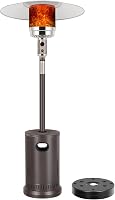
Choose the Amazon Basics for chairs arranged around an open outdoor spot where a tall heater can stand clear of furniture. Its 46,000 BTU output and claimed reach of up to a 9 ft radius make it the broader-zone propane choice here.
It measures about 32.1 x 32.1 x 91.3 in, so check both floor space and overhead clearance. The heater needs a 20 lb propane tank, which isn't included.
Wheels help with positioning, while a water box provides base ballast and an included chain secures the tank. Follow the assembly instructions for both rather than assuming the empty base is ready for use.
One-touch ignition and adjustable output suit evenings when you want to start quickly and turn the heat down later. Move and position the heater only as its manual allows, with the unit off and cool.
Skip it for low roofs, cramped balconies or layouts without a clear central position. A large output number won't help if safe placement puts the heater far from everyone.
For fuel choices, read propane vs electric patio heaters. Our best propane patio heaters guide covers other options in this category.
Haimmy infrared tower: for nearby seats with power access
Choose the Haimmy for a defined seating spot facing the heater, such as a pair of chairs with suitable outlet access. Its electric format avoids propane tank changes and lets you adjust heat from your seat with the remote.
The tower has 9 heat levels from 620 to 1,500 W, plus a 1 to 9 hour timer. Start with a suitable position, then adjust output for comfort rather than using maximum heat to compensate for distant seating.
Its base footprint is 9.6 x 12 in. Tip-over protection, overheat protection and a safety lock are useful features, but they don't replace a clear position away from traffic and nearby materials.
Haimmy gives it IPX5 water resistance. Follow its weather and electrical instructions; that protection doesn't extend to an outlet or connection elsewhere in your setup.
Skip it for widely spread guests or a location that requires an unsafe cord route. At full power it draws 12.5 A, so check the circuit's capacity and other connected loads.
Our best electric patio heaters guide compares alternatives, while how a patio heater works explains radiant heat.
How do wind, cold and open sides change your choice?
Choose a more compact seating zone in exposed conditions, rather than assuming extra output will warm the entire patio. Wind increases heat loss from people and makes comfort less even.
Infrared heat can still reach you through moving air, but wind continues to cool exposed skin and clothing. A heater that feels useful on a calm evening may provide less comfort in the same spot during a breeze.
Look at the direction wind usually crosses the patio. An existing wall may provide shelter, but the heater still needs its required clearances and ventilation.
Don't wrap an outdoor propane heater in screens, curtains or temporary walls to trap warmth. Changing the enclosure can create a location the heater isn't approved to use.
Colder weather also narrows reasonable expectations. Plan for warm clothing and a close gathering rather than expecting an outdoor heater to create indoor comfort across an open yard.
For a deck, check exposure and walking space together. Our guide to outdoor heaters for decks covers the location-specific trade-offs.
Is one large heater better than 2 smaller heaters?
Choose one heater for one close gathering and consider separate heaters for distinct seating zones. Two areas divided by distance or furniture often benefit more from separate heat placement than from a larger central unit.
A long dining table is a common example. If one end is close to the heater and the other is far away, increasing output can make the near seats uncomfortable before the far seats feel warm.
First try a different furniture arrangement that keeps all chairs within useful reach. If that doesn't work, assess separate heater positions with enough clearance between each unit and nearby materials.
For electric heaters, account for the combined electrical load. Don't assume separate outlets use separate circuits; get help from an electrician if you can't confirm suitable capacity.
For propane, allow space to reach controls and shut off each fuel supply. More heaters also mean more tanks to manage, more hot surfaces and more equipment to store.
Avoid adding a second heater merely to cover empty space. Add it when there is a separate occupied zone and a safe way to serve it.
Where can you safely set up the heater?
Set up only where the model's clearance, surface and ventilation rules all fit. Clearance requirements vary, so there isn't one distance that works for every outdoor heater.
Read the manual before buying and measure above, behind and around the proposed position. Include chair movement, umbrella fabric, awnings, branches and cushions in those measurements.
For covered areas, read our guide on using a patio heater under a covered patio. An open-sided roof doesn't automatically make a location suitable for propane heat.
Place a floor heater on the firm, level surface its instructions require. Keep it out of routes used by children, pets and people carrying food.
For propane, assemble the unit fully and check connections for leaks using the manual's approved method. Never use a flame to look for a leak.
For electric heat, use the required outdoor electrical protection and a suitable outlet. Don't use a power strip or improvise with an extension cord; follow the heater's connection instructions.
A timer, tip-over switch or heat guard doesn't make unattended use safe. Keep someone present while the heater runs and maintain a clear route to its controls.
What setup and care mistakes reduce useful warmth?
Keep the heater correctly placed, clean and in sound condition so its intended heat can reach the seats. Maintenance won't increase its rated output, but neglect can create poor operation or unsafe use.
Don't hide the heater behind furniture to make it less visible. Tables, chair backs and other objects can interrupt the path of radiant heat.
Avoid putting the nearest seat too close and then judging the heater by that seat alone. Check the farthest occupied chair while keeping everyone within the manual's permitted distances.
After each use, turn the heater off and shut down its fuel or electrical supply as directed. Let it cool fully before moving it, cleaning it or fitting a cover.
Clean guards, reflectors and accessible surfaces only by the method in the manual. Don't bend guards, poke burner openings or alter safety switches.
Check propane hoses and electrical cords for damage before use, especially after storage. Stop using the heater if you find damage, loose parts or signs of abnormal operation.
Store it as directed and keep vents clear of debris. Our patio heater cover guide explains how a cover fits into that routine.
What size outdoor heater should you choose?
Choose the heater that reaches your regular seats from a safe, usable position. Make the final decision from your furniture layout, not the largest coverage number on the box.
- Choose the Cuisinart for a close group around one suitable table with room for the heater and its required clearances.
- Choose the Amazon Basics for a wider outdoor gathering arranged around a clear central spot with enough overhead space.
- Choose the Haimmy for nearby chairs facing a directional heat source, with a suitable outlet and circuit.
- Plan separate zones when people regularly use seating areas that one heater can't reach evenly.
Before ordering, mark the heater's footprint and clearance zone on your patio sketch. If that pushes chairs into walkways or leaves the main seats too far away, change the layout or heater format.
For the next step, use our guide on how to choose a patio heater for a porch or deck to narrow the fuel and format that fit your space.
Frequently asked questions
What size outdoor heater do I need for a 10 x 10 patio?
Choose for the occupied seating zone within your 100 sq ft patio, then check clearances. A tabletop heater can suit a close group without warming the full floor area.
For seats spread across the patio, compare a freestanding heater's reach or divide the layout into separate warming zones.
How many BTUs do I need for a patio heater?
There isn't a reliable universal BTU target for an open patio. Start with the heater's coverage guidance, seating distance and placement requirements, then account for wind and your usual weather.
More output can help a broader gathering, but it won't solve a position that leaves people outside the useful heat zone.
Are electric patio heaters sized by square feet?
Some electric heaters include a square-foot coverage claim, but placement and direction matter more outdoors than the number alone. Compare wattage, heat settings and the path between the heater and your chairs.
Don't assume an indoor-style area claim means the heater will warm every seat across an open patio.
Does a patio heater warm an entire patio?
A patio heater usually provides comfort within a seating zone rather than warming all the air across an open patio. Nearby people with a clear path to radiant heat benefit most.
Long tables, widely spaced chairs and wind can leave some seats cooler even when the total patio area sounds suitable.
Should I use a larger patio heater for a covered area?
A covered area needs a suitable heater and enough clearance before it needs more output. Check the model's rules for overhead materials, side clearances and ventilation.
If those requirements don't fit, choose another heater or position instead of placing a larger unit closer to the roof or surrounding furniture.