7 Best Electric Patio Heaters (October 2026)
The best electric patio heaters include the Hykolity 1500W Wall-Mount Infrared Patio Heater for fixed patio seating, the Haimmy 42-Inch Infrared Patio Heater for shared porch seating, and the Hykolity 38.5-Inch Electric Patio Heater for simple porch routines.
On this page (8 sections)
- Which best electric patio heater pick fits your space?
- The best electric patio heaters by use
- How should you choose an electric patio heater?
- Can your outlet and circuit support a patio heater?
- How should you set up an electric patio heater?
- How do you care for an outdoor electric heater?
- What mistakes make electric patio heaters less useful?
- Which electric patio heater should you buy?
The Hykolity wall mount is the best electric patio heater for fixed seating, while the Haimmy tower suits people who want movable placement and finer heat adjustment. Start with where you sit and where the heater can safely go, then compare controls.
Electric patio heaters make sense when a suitable outlet is close to the chairs and you want warmth without storing fuel. For the differences between heat sources, see our guide to propane, electric and infrared patio heaters.
Plan around the seats you actually use rather than the whole deck. Our guide to what size patio heater you need helps you match the heating zone to your layout.
Our picks at a glance
-
1
 Best for fixed patio seating
Hykolity 1500W Wall-Mount Infrared Patio Heater
8.4/10 our score
See it on Amazon -
2
 Best for shared porch seating
Haimmy 42-Inch Infrared Patio Heater
8.2/10 our score
See it on Amazon -
3
 Best for simple porch routines
Hykolity 38.5-Inch Electric Patio Heater
8.1/10 our score
See it on Amazon
- 4
 Check it
Vagkri 42-Inch Infrared Patio Heater
Best for grouped patio chairs - 5
 Check it
SereneLife 900W Infrared Patio Heater
Best for a reading corner - 6
 Check it
Vagkri Infrared Patio Heater with Remote
Best for changing seating layouts - 7
 Check it
ThermoMate 1500W Electric Patio Heater
Best for future patio changes
Which best electric patio heater pick fits your space?
Choose a wall mount for permanent seating, a tower for placement changes, or a dual-mount model if your patio plan is still taking shape. None of these heaters should be chosen on wattage alone.
MellowMantel compared mounting options, output controls, weather protection and safety features. The scores reflect those features and their usefulness for common patio layouts.
Most picks share the same maximum power, so paying attention to format is more useful than expecting one to warm a much larger outdoor area. A heater that can face your chairs from a suitable position is the stronger choice.
| Product | Best for | Mount | Power | Weather protection | Our score |
|---|---|---|---|---|---|
| Hykolity 1500W Wall-Mount Infrared Patio Heater | fixed patio seating | Wall mount | 1500W | IP55 | 8.4 |
| Haimmy 42-Inch Infrared Patio Heater | shared porch seating | Floor standing tower | 620–1500W | IPX5 | 8.2 |
| Hykolity 38.5-Inch Electric Patio Heater | simple porch routines | Floor standing | 1500W | Confirm permitted exposure in manual | 8.1 |
| Vagkri 42-Inch Infrared Patio Heater | grouped patio chairs | Floor standing tower | 620–1500W | IPX5 | 8.0 |
| SereneLife 900W Infrared Patio Heater | a reading corner | Floor standing tower | 900W | IP65 | 7.8 |
| Vagkri Infrared Patio Heater with Remote | changing seating layouts | Wall mount or tripod | 700W, 1000W or 1500W | IP65 | 7.7 |
| ThermoMate 1500W Electric Patio Heater | future patio changes | Wall or floor | 1500W | IP65 | 7.6 |
The best electric patio heaters by use
The Hykolity wall mount is the first choice for a settled seating plan. The alternatives below solve different placement and control needs, from a single reading chair to a patio that gets rearranged.
Hykolity 1500W Wall-Mount Infrared Patio Heater
- 1500W infrared heat
- 3 power levels
- IP55 weather protection
- 0–24 hour timer
Choose this wall heater when your chairs stay in one place and you want to keep the floor clear. The remote makes adjustments easy from your seat.
Pros
- Keeps floor space open
- Three heat settings
- Remote control and shutoff timer
Cons
- Requires a suitable mounting surface
- Cannot follow changing seating arrangements
Choose the Hykolity wall heater when your dining table or lounge chairs stay beside a suitable wall. It removes the heater base from the walking area, which matters on a narrow porch or a patio with limited space around furniture.
Its 3 heat levels offer a middle setting between low and full output. The remote is useful once everyone is seated, while the shutoff timer can end a session without another trip to the controls.
Hykolity specifies IP55 protection and a corrosion-resistant aluminum housing. Placement still needs to follow the manual, including the space required above, beside and in front of the heater.
Skip it if you regularly move your chairs or want warmth in several separate corners. A fixed heater serves the area it faces, and mounting it near an outlet is only useful if that position also reaches your seats.
Before drilling, measure from the proposed mounting point to the seating zone and nearby roof, curtains and furniture. Confirm the wall can support the approved hardware.
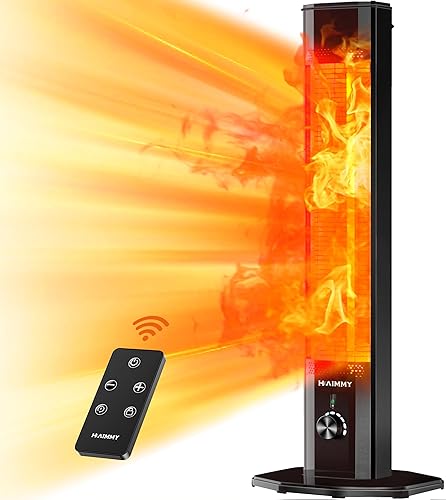
Haimmy 42-Inch Infrared Patio Heater
- 620–1500W output
- 9 heat levels
- IPX5 water resistance
- Safety lock
Fine heat adjustment suits a porch used by people with different warmth preferences. A safety lock helps prevent unwanted control changes.
Pros
- Nine output settings
- Remote and 1–9 hour timer
- Tip-over and overheat shutoff
Cons
- Needs a clear floor position
- Cannot mount on a wall
Choose the Haimmy for a shared porch where one person wants gentle warmth and another prefers stronger output. Its 9 settings from 620W to 1500W give you smaller steps than the simpler Hykolity standing model.
The safety lock helps prevent unwanted control changes, which is useful in a shared household. It does not make the guard safe to touch or remove the need to keep children and pets away.
This tower has a carrying handle and a place to store the remote. Those details suit a heater that gets put away between sessions, provided it is switched off, unplugged and cool before moving.
The 1–9 hour timer covers ordinary patio sessions without needing a full-day range. Its longer heating tube also makes it worth considering when you want warmth directed along a seated person's body.
Skip it if there is no clear floor position near the chairs. For a permanent installation that frees the walking area, compare the best wall mounted patio heaters.
Hykolity 38.5-Inch Electric Patio Heater
- 1500W infrared heat
- 2 heat levels
- Remote control
- 0–24 hour timer
Two heat settings suit buyers who want simple controls and a standing design. Account for its automatic restart behavior before choosing a busy patio spot.
Pros
- Straightforward heat selection
- Remote and shutoff timer
- Tip-over and overheat protection
Cons
- Less precise adjustment than multi-level towers
- Restarts when returned upright after a tip-over
Choose the Hykolity standing heater if your routine is simple: put the heater in its approved position, select a heat level and sit down. Its 2 settings avoid cycling through a long menu of output choices.
The remote and 0–24 hour shutoff timer add convenience without changing that basic approach. This is a better fit for someone who wants straightforward controls than someone who often finds one setting too warm and the next too cool.
One behavior deserves attention: the heater automatically restarts when returned upright after a tip-over. Switch it off and disconnect power before handling it after a fall, then check for damage before reuse.
A quiet corner away from foot traffic is a better location than the gap between a table and a doorway. Safety shutoffs do not make repeated bumps or unstable placement acceptable.
Skip this model if fine heat adjustment is your main reason for upgrading. Also confirm its permitted weather exposure in the manual before planning an exposed outdoor position.
Vagkri 42-Inch Infrared Patio Heater
- 620–1500W output
- 9 power settings
- 1–24 hour timer
- 100-degree heating angle
The stated heating angle suits chairs grouped in front of the tower. Choose it for fine output control without wall installation.
Pros
- Nine output settings
- Remote and shutoff timer
- Vagkri identifies it as ETL certified
Cons
- Needs floor space
- Directional heat requires thoughtful chair placement
Choose the Vagkri tower for chairs grouped in front of the heater rather than seating spread around it. Vagkri describes a 100-degree heating angle, so think of a forward-facing seating zone rather than warmth in every direction.
Its 9 output settings and remote suit an evening that starts mild and gets cooler. The 1–24 hour timer offers a broad shutoff range, though a long timer is not a reason to leave a heater operating unattended.
The aluminum body and outdoor design suit patio use within the brand's instructions. Vagkri identifies the heater as ETL certified, but certification does not replace checking your cord route, clearances and power connection.
Choose the position before choosing the setting. A chair outside the heating direction may need to move; turning the output up can leave the nearest person too warm without solving the distant seat's problem.
Skip it for people sitting on opposite sides of a large table. Also consider a wall heater if the only available floor position would obstruct a busy route.
SereneLife 900W Infrared Patio Heater
- 900W infrared heat
- Brand-claimed 15 sq ft coverage
- IP65 weather protection
- Remote control
A focused option for one compact seating spot. Its lower maximum output makes it a poor match for chairs spread across an open deck.
Pros
- Lower full-power draw than the other picks
- Remote control
- Tip-over and overheat protection
Cons
- Less maximum output than the other picks
- Limited brand-claimed coverage
Choose the SereneLife for one compact seating spot, such as a reading chair on a sheltered porch. Its 900W maximum output is better matched to that focused job than to a wide gathering area.
SereneLife claims coverage of 15 sq ft. Use that as a reason to keep expectations local, rather than assuming the heater will make an entire balcony or deck comfortable.
The remote lets you change the heat from your chair, and the tower weighs 7.7 lb. That makes its weight worth considering if your routine includes carrying a cooled heater to indoor storage.
SereneLife specifies IP65 protection, a mesh guard, tip-over shutoff and overheat protection. The guard limits direct access to the heating element, but the heater still needs clear space from people and fabrics.
Skip it for a group with widely spaced seats or a patio that regularly feels windy. Its lower draw is useful only if the available warmth meets your needs; running a smaller heater longer will not fix poor placement.
Vagkri Infrared Patio Heater with Remote
- 700W, 1000W and 1500W settings
- Wall or tripod mounting
- 12-hour timer
- IP65 weather protection
Choose a tripod position for a changing layout or a wall installation for a permanent seating zone. Adjustable stand height helps align the heater with the seats.
Pros
- Wall and tripod setup options
- Adjustable stand height
- Remote and three heat settings
Cons
- Tripod legs require clear floor space
- Moving between mounting methods requires setup
Choose this Vagkri if your seating layout changes enough to make a fixed tower position awkward. Its wall or tripod setup lets you choose a permanent location or position the heater on a stand.
The tripod adjusts from 33 to 77 inches. That range helps you align the heater with the occupied area, but the final height and angle must remain within the installation instructions.
Its 3 output settings are 700W, 1000W and 1500W, giving you a useful middle step without the longer control range of the towers. A remote and 12-hour timer handle adjustments from your seat.
Measure the tripod's full footprint before choosing it for a narrow balcony. The heater head may fit a space that cannot safely accommodate the legs and a walking route.
Skip it if the stand would sit beside a doorway or in the path of guests. Wall mounting may solve that problem, but only when the wall position also provides the required clearance and a clear path for heat.
ThermoMate 1500W Electric Patio Heater
- 1500W carbon fiber infrared heat
- Freestanding or wall mounted
- 8 heat levels
- IP65 weather protection
Start with a freestanding tower or use the included wall hardware for a fixed setup. Eight heat settings suit buyers who want both mounting choice and fine adjustment.
Pros
- Floor base and wall mounting hardware
- Eight heat levels
- Tip-over and overheat protection
Cons
- Eight-hour timer is shorter than several alternatives
- Wall placement must meet mounting clearances
Choose the ThermoMate if you expect to change your patio arrangement and want to keep both installation choices open. It includes a floor base and wall mounting hardware, so you can choose the format that fits your space.
Its 8 heat levels provide finer adjustment than the simpler dual-mount Vagkri. The remote and LED display suit buyers who want to make and see setting changes without relying on a single basic control.
ThermoMate claims coverage up to 100 sq ft. That claim is not directly comparable with another brand's coverage figure because outdoor layout, exposure and placement can differ.
The 8-hour timer is enough for many evening sessions. Choosing a longer timer elsewhere makes little sense if you normally switch the heater off after dinner.
Skip it if your wall location is already decided and you prefer the simpler fixed format of the top pick. Choose it for the combination of mounting choice and output adjustment, rather than the largest stated coverage area.
How should you choose an electric patio heater?
Choose by seat position, safe placement and power access before comparing extra features. These determine whether you can use the heater effectively; a remote or extra timer range cannot correct a poor location.
Which electric patio heater format fits your layout?
A wall mount suits furniture that stays put, while a tower suits a layout you change between uses. A tripod adds height adjustment but needs room for its legs.
Walk through the patio as people would during a meal. If the only floor position blocks access to a door, grill or chair, a standing heater is the wrong format for that spot.
Renters should check mounting permission before choosing a wall unit. A portable heater avoids drilling, but it still requires a stable surface and a cord route that does not cross foot traffic.
How far away will people sit?
Choose a location that puts the occupied seats within the heater's permitted operating range. Infrared heat needs a clear path to people and surfaces, so furniture and solid barriers can create cooler spots.
A heater across the patio may be less useful than one correctly positioned near a small seating group. Do not move it closer than the required clearance to chase more warmth.
Wind can also carry heat away from your body and make the same setup feel less comfortable. A sheltered seating plan often matters more than another control setting.
Do more heat settings make a heater stronger?
More settings provide finer adjustment, not a higher maximum output. They help when the nearest person gets too warm or when you want gentle heat during a mild evening.
Two or 3 levels may be enough if you usually use one familiar setting. Choose more levels when small comfort changes matter, rather than assuming a longer settings menu means better coverage.
What does weather protection tell you?
Weather protection helps you judge exposure, but it does not approve every outdoor setup. Follow the heater's instructions for use, mounting and storage even when the housing has an IP designation.
IPX5 describes water protection without specifying a dust protection level in that code. IP55 and IP65 include both dust and water protection, but none of these designations makes a heater suitable for immersion.
The electrical connection needs its own protection. A weather-resistant heater body does not make an exposed plug connection suitable for rain.
For roof height and nearby surfaces, read our guide to using a patio heater under a covered patio.
Can your outlet and circuit support a patio heater?
A suitable outlet and enough available circuit capacity are required before you buy. Check the heater's electrical requirements and account for other appliances using the same circuit.
At 120V, a 1500W heater draws about 12.5 amps. Two such heaters can overload a common household circuit, even when they are plugged into different outlets on that circuit.
Use the connection required by the manual, with GFCI protection where required for outdoor use. Do not use a power strip or assume an extension cord is acceptable.
If the cord cannot reach safely, choose another location or ask an electrician about a suitable outlet. Do not route it under rugs, pinch it in a door or stretch it across a walking path.
How do you estimate running cost?
Multiply kilowatts by hours of use, then multiply by your electricity rate. At full output, a 1500W heater uses 1.5 kWh per hour, compared with 0.9 kWh for a 900W heater.
A lower setting reduces consumption while it is selected. A timer saves energy only by limiting operating time; it does not make the same heat setting use less electricity.
Use our guide to electric patio heater running costs to work out your likely expense. Plan around the setting you expect to use, rather than assuming the lowest setting will always be enough.
How should you set up an electric patio heater?
Set up the heater with the power disconnected, following the supplied assembly and placement instructions. Check the full surrounding space before switching it on.
- Choose the seating zone. Identify the chairs you want to warm and the direction the heater will face.
- Measure clearances. Check overhead surfaces, railings, cushions, curtains, plants and furniture against the manual's distances.
- Secure the heater. Fully assemble the approved base or attach the mounting hardware to a suitable surface.
- Plan the connection. Keep the cord clear of hot parts, standing water and walking routes.
- Check the final position. Make sure furniture movement will not push a chair or fabric into the clearance area.
- Start with a lower setting. Adjust while seated in the intended position, staying outside the required clearance.
For wall mounting, do not assume anchors supplied with a heater suit every wall material. Use the approved fastening method for your surface, and get qualified help if you cannot confirm secure attachment.
For floor models, check stability on the actual surface. Uneven paving, loose gravel and sloped decking can make a location unsuitable even when there is enough open space.
Which safety features should guide your choice?
Tip-over shutoff and overheat protection are useful safeguards for standing heaters. A control lock serves a different purpose: it helps prevent unwanted operation or setting changes.
None of these features makes a heater safe to cover or place beside fabric. Keep children and pets away from the hot area, and switch off the heater when leaving the seating space.
If a heater tips, disconnect power before handling it. This matters especially with a model that resumes heating when returned upright.
How do you care for an outdoor electric heater?
Unplug the heater and let it cool fully before cleaning, moving or covering it. Follow the manual's cleaning method so you do not damage the heating element or electrical parts.
Before each session, look for cord damage, a loose base, damaged guards or loose mounting hardware. Stop using the heater if it is damaged or no longer stands or mounts securely.
Remove surface dust as directed rather than spraying the heater with a hose. Keep vents and guards clear, and never drape a towel or clothing over the unit.
For storage, choose the dry location or protective arrangement allowed by the brand. Our guide to patio heater covers explains when a cover helps and why it must only go on a cool heater.
What mistakes make electric patio heaters less useful?
The biggest mistake is expecting one heater to warm a whole open patio. Focus on occupied seats, then check that the heater can face them from an approved position.
- Choosing by coverage claims alone. Brands may use different conditions, so compare mounting, direction and output before relying on square footage.
- Ignoring the farthest chair. Arrange seating within the useful heating zone instead of making the nearest seat uncomfortably warm.
- Buying a tripod for a narrow route. Account for the legs, cord and space needed to pull chairs out.
- Treating a timer as supervision. Set it to match the session, then switch the heater off when you leave.
- Adding heaters without checking the circuit. More outlets do not necessarily mean more available electrical capacity.
- Leaving cushions inside the clearance area. Check where furniture moves during use, not just where it sits during setup.
If your seating is spread widely across an exposed deck, reconsider the heating plan before adding more electric units. A tighter seating group may solve the problem with fewer power and placement demands.
Which electric patio heater should you buy?
Choose the Hykolity wall mount if your seats are fixed and the mounting position works. Choose the Haimmy tower if you need movable placement and small steps between heat settings.
Pick the standing Hykolity for simpler controls, or the Vagkri tower for chairs grouped within its forward heating area. The SereneLife is the focused choice for a compact reading spot.
For changing layouts, choose the Vagkri tripod model when adjustable height matters. Choose ThermoMate when you want a floor base, wall mounting hardware and fine heat adjustment in one option.
The best electric patio heater is the one you can position correctly beside the seats you use. Confirm clearances and power access before ordering, then choose the controls that match your routine.
If your patio cannot support that setup, compare electric versus propane patio heaters. For more options using directional radiant heat, see the best infrared patio heaters.
Our top 3 picks at a glance
-
1
Best for fixed patio seating
Hykolity 1500W Wall-Mount Infrared Patio Heater
8.4/10 our score
See it on Amazon -
2
Best for shared porch seating
Haimmy 42-Inch Infrared Patio Heater
8.2/10 our score
See it on Amazon -
3
Best for simple porch routines
Hykolity 38.5-Inch Electric Patio Heater
8.1/10 our score
See it on Amazon
Frequently asked questions
Are electric patio heaters good for outdoor use?
Yes, outdoor electric patio heaters work well for focused warmth near seating when you have a suitable outlet. They are most useful when aimed toward people within the permitted operating distance.
Choose a model approved for your location, follow its clearances and expect wind and seat spacing to affect comfort.
What size electric patio heater do I need?
Size the heater around the occupied seating zone rather than your entire patio. Most picks here reach 1500W, but equal wattage does not mean equal heat distribution.
Check the permitted placement distance and heating direction, then decide whether all seats can fit in front of the heater without crowding it.
Can an electric patio heater stay outside?
Only leave it outside when its instructions allow the exact exposure and storage conditions. Weather protection does not make the plug, outlet or every installation suitable for rain.
Switch it off, unplug it and let it cool before moving or covering it, then follow the brand's storage directions.
Do electric patio heaters cost a lot to run?
Cost depends on the selected wattage, operating time and your electricity rate. At full output, a 1500W heater uses 1.5 kWh in an hour; a 900W heater uses 0.9 kWh.
Multiply that consumption by your rate, or use our electric patio heater cost guide to plan an evening's use.
Are wall mounted or freestanding patio heaters better?
Wall mounted heaters are better for fixed seating where floor space is limited. Freestanding heaters suit changing layouts and locations where mounting is impractical.
Neither format solves a poor power connection or blocked heat path, so check outlet reach, required clearances and furniture placement before choosing between them.