5 Best Wall Mounted Patio Heaters (October 2026)
The best wall-mounted patio heaters include the Hykolity 1500W Wall-Mount Infrared Patio Heater for fixed seating areas, the Sundate Ceiling Hanging Infrared Heater for app-focused households, and the Kihdockood Wall or Standing Infrared Heater for changing patio layouts.
On this page (9 sections)
- The best wall mounted patio heaters for different patios
- How do you match a wall mounted patio heater to your seating area?
- What should you check before mounting a patio heater?
- How much weather protection does a wall heater need?
- Are wall-mounted patio heaters cheaper to run?
- Which controls will you actually use?
- How should you use and care for a mounted heater?
- Which mistakes make a patio heater a poor fit?
- Which wall mounted patio heater should you choose?
The Hykolity 1500W Wall-Mount Infrared Patio Heater is the best wall mounted patio heater here for a fixed seating area and straightforward controls. Choose Sundate for app access, or Kihdockood if you want the option to move between wall and floor placement.
The best fit starts with your chairs, wall and power supply. A heater with more controls won't help if its permitted mounting position directs warmth away from the people using the patio.
All 5 picks provide up to 1500 watts, so this comparison centers on placement, adjustment and convenience. None has a supported coverage figure here that would justify promising warmth across a particular patio size.
For other electric formats, see the best electric patio heaters. Our best infrared patio heaters guide helps if you're still deciding between wall, standing and other arrangements.
Our picks at a glance
-
1
 Best for fixed seating areas
Hykolity 1500W Wall-Mount Infrared Patio Heater
8.4/10 our score
See it on Amazon -
2
 Best for app-focused households
Sundate Ceiling Hanging Infrared Heater
7.4/10 our score
See it on Amazon -
3
 Best for changing patio layouts
Kihdockood Wall or Standing Infrared Heater
7.3/10 our score
See it on Amazon
- 4
 Check it
Danluke 1500W Wall-Mount Patio Heater
Best for narrow wall spaces - 5
 Check it
Sundate Wall-Mount Patio Heater with Light
Best for evening seating corners
The best wall mounted patio heaters for different patios
Choose Hykolity for a permanent seating zone, Sundate for connected controls, or Kihdockood for layout changes. Danluke suits limited wall width, while Sundate's model with a light adds another function to an evening seating corner.
We compared mounting options, controls, heat adjustments and weather protection. The scores reflect those features and their usefulness for this particular search.
Start with the mounting row below, then compare controls. A heater that fits the approved location is a better choice than a more feature-rich model that needs a different wall or ceiling arrangement.
| Product | Best for | Power | Mounting | Controls | Our score |
|---|---|---|---|---|---|
| Hykolity 1500W Wall-Mount Infrared Patio Heater | fixed seating areas | 1500 watts | Wall mount | Remote, 3 levels, 0 to 24 hour timer | 8.4 |
| Sundate Ceiling Hanging Infrared Heater | app-focused households | 1500 watts | Ceiling mount; confirm permitted bracket positions | WiFi, remote, touch, 9 levels | 7.4 |
| Kihdockood Wall or Standing Infrared Heater | changing patio layouts | 1500 watts | Wall mount or freestanding | Remote, 8 levels, 24 hour timer | 7.3 |
| Danluke 1500W Wall-Mount Patio Heater | narrow wall spaces | 1500 watts | Wall mount | Remote and touch | 7.0 |
| Sundate Wall-Mount Patio Heater with Light | evening seating corners | 1500 watts | Wall mount | WiFi, remote, 9 levels | 6.9 |
Hykolity 1500W Wall-Mount Infrared Patio Heater
Hykolity 1500W Wall-Mount Infrared Patio Heater
- 1500 watts
- 3 power levels
- Remote control
- 0 to 24 hour timer
- IP55 weather protection
A straightforward choice for a seating area that stays in one place. Its remote, timer and 3 power levels cover everyday adjustments without an app.
Pros
- Simple choice of 3 heat levels
- Remote and timer
- Corrosion-resistant aluminum housing
Cons
- No WiFi control
- Fewer heat steps than the 8- and 9-level options
Hykolity suits a patio where the sofa or dining table stays in one place. Its 3 power levels, remote and 0 to 24 hour timer cover the main adjustments without requiring a phone.
Fewer levels can be an advantage if you prefer a simple choice between gentler and stronger heat. They are less appealing if small output changes matter during long evenings as the temperature drops.
The heater has IP55 protection and a corrosion-resistant aluminum housing. Hykolity identifies it as ETL certified, with overheat cutoff and tip-over shutoff.
For a permanent installation, secure mounting remains the priority. A shutoff feature doesn't make a loose bracket or unsuitable wall acceptable.
Mounting hardware, screws or bolts, anchors and a manual are included. Match the fasteners to the actual wall construction rather than assuming the supplied anchors suit every surface.
Buy it for a settled seating layout and simple daily operation. Skip it if smartphone control is essential or you expect to move the heat between several patio areas.
Sundate Ceiling Hanging Infrared Heater
Sundate Ceiling Hanging Infrared Heater
- 1500 watts
- 9 heat levels
- WiFi, remote and touch controls
- 24 hour timer
- Ceiling mount
Several control methods suit households that want smartphone access and a separate remote. Confirm the approved mounting orientation before planning a wall or overhead installation.
Pros
- WiFi, remote and touch controls
- 9 heat levels
- Automatic shutoff timer
Cons
- Wall and ceiling mounting guidance needs confirmation
- No specific IP code supplied
This Sundate suits buyers who want to adjust warmth through WiFi, a remote or touch controls. Its 9 heat levels provide more adjustment steps than Hykolity, while a 24 hour timer handles automatic shutoff.
The extra control methods are useful when several people share a patio. One person can use the remote without needing access to the phone used for the app.
Confirm the mounting orientation before buying. This model is described for wall-mounted and hanging use, while its mounting specification identifies a ceiling mount.
That distinction matters if your only suitable location is a vertical wall. Get the approved bracket positions and clearances settled before arranging furniture around it.
Sundate describes the heater as weatherproof, but no specific IP code is supplied here. Choose its exposure level from the manual rather than assuming it matches another Sundate model.
Pick it when connected controls and an approved overhead location solve your layout. Skip it if you need a clearly established wall-only installation or a specific ingress-protection code for an exposed position.
Kihdockood Wall or Standing Infrared Heater
Kihdockood Wall or Standing Infrared Heater
- 1500 watts
- 8 heat levels
- Wall mount or freestanding
- Remote control
- 24 hour timer
Wall and freestanding modes suit a patio whose furniture arrangement may change. Angle adjustment helps direct warmth when the heater is mounted.
Pros
- Wall or floor placement
- Up to 45-degree wall angle adjustment
- IP65 protection
Cons
- Standing base takes floor space
- Wall hardware requirements need confirmation
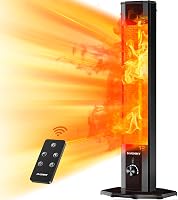
Kihdockood is the most useful choice here if your furniture arrangement changes with the season. It supports wall mounting and freestanding use, so you're not buying solely for one fixed position.
Its remote provides 8 heat levels and a 24 hour timer. Wall-mounted angle adjustment of up to 45 degrees helps aim warmth toward the occupied area within the permitted installation range.
The heater has IP65 protection and stands about 41 inches tall in tower form. Its base needs a stable spot outside the route between the patio door, table and chairs.
Tip-over protection shuts it off if it tips, and a metal mesh guard helps keep objects away from the heating area. Keep clothing, cushions and other loose items clear regardless of the guard.
A base stand is included; confirm the wall bracket and fastener requirements before planning that mode. Switching formats still involves proper assembly and a safe cord route.
Choose it for a layout that may change. Skip it if you want a compact horizontal wall unit or can't spare a safe floor position for the tower.
Danluke 1500W Wall-Mount Patio Heater
Danluke 1500W Wall-Mount Patio Heater
- 1500 watts
- Wall mount
- Remote and touch controls
- Carbon fiber heating element
- 120 volts
A compact body suits a wall with limited usable width, provided all clearances fit. Remote and touch controls give you 2 ways to make adjustments.
Pros
- Compact body
- Remote and touch controls
- 120 volt power
Cons
- No specific IP code supplied
- Heat-level count and timer need confirmation if essential
Danluke makes sense when usable wall width is limited. Its body measures about 25.59 x 5.16 x 2.36 inches, though the space needed for installation also includes all required clearances.
Remote and touch controls let you make changes from your seat or at the unit. Think about access to those touch controls before choosing the mounting height; convenience never overrides the required position.
The carbon fiber heater operates on 120 volt power. A nearby outlet is useful only if its circuit, protection and location also meet the heater's requirements.
Danluke describes it for outdoor living spaces, including covered patios, decks and gazebos. No specific IP code is supplied here, so don't choose it for direct exposure based only on the word “outdoor.”
Buy it for a compact fixed installation with straightforward control access. Skip it if a shutoff timer, a known number of heat levels or a stated ingress-protection code is essential without further confirmation.
Sundate Wall-Mount Patio Heater with Light
Sundate Wall-Mount Patio Heater with Light
- 1500 watts
- 9 heat levels
- WiFi and remote control
- 24 hour timer
- Built-in light
Built-in lighting makes this worth considering for an evening seating corner. Check its IP34 protection and mounting requirements against the proposed location.
Pros
- Built-in light
- WiFi and 2 supplied remotes
- 9 heat levels
Cons
- Lower water protection than the IP55 and IP65 picks
- Light brightness and coverage need confirmation
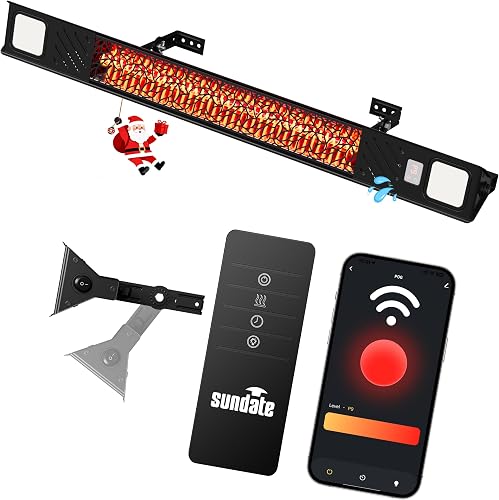
This Sundate fits buyers who want heat and a built-in light above an evening seating area. Lighting brightness and coverage aren't specified, so keep a separate plan for steps, paths and other places that need dependable illumination.
It provides WiFi control, 9 heat levels and a 1 to 24 hour timer. Sundate supplies 2 remotes, which is useful if you want a spare rather than relying entirely on a phone.
Its IP34 protection offers less water-ingress protection than the IP55 and IP65 picks. Placement under a suitable cover deserves particular attention, following the model's own instructions.
The body measures about 39.37 x 4.33 x 4.33 inches, and wall brackets are included. Allow room for the full body and clearances before deciding it will fit above a narrow seating corner.
Choose it when the light is a useful extra and the location meets its installation limits. Skip it when weather exposure is the main concern or you need the heater's light to serve as your only patio lighting.
How do you match a wall mounted patio heater to your seating area?
Plan the occupied zone first, then find a permitted mounting position that faces it. Infrared heat warms people and surfaces in its path, so furniture placement matters as much as the heater's feature list.
A compact table against a suitable wall is a simpler match than chairs scattered across an open deck. If people sit on several sides of a large table, consider which seats will face the heater and which will face away.
Aim your wall-mounted patio heater at people
Draw the wall, table and usual chair positions before ordering. Mark the proposed heater position and check the manual's mounting height, angle and clearance requirements against that drawing.
A tall chair back or other furniture can interrupt the path of radiant warmth. Avoid placing the heater where it mainly faces a barrier instead of the people you want to warm.
Distance matters, too. Mounting higher or farther away than the intended operating position can leave the seating area feeling less warm even though the heater is drawing full power.
Match the heater to the patio's shelter
A sheltered seating corner is generally easier to keep comfortable than an open, windy deck. Infrared heat doesn't depend on warming all the surrounding air, but wind still cools people and exposed surfaces.
Don't add curtains or screens close to the heater to trap warmth. Any new fabric or panel must remain outside its required clearances.
For a larger area, use our guide to what size patio heater you need before assuming one unit will serve every seat. If the layout needs broad, movable heat, reconsider the format before committing to wall brackets.
What should you check before mounting a patio heater?
Confirm the wall structure, electrical supply, clearances and exposure before drilling. These checks determine whether the chosen heater belongs in that location at all.
Check the structure behind the finish
Siding, thin paneling and decorative trim aren't automatically suitable support points. The bracket must attach to a structure and fasteners appropriate for the heater and the wall material.
Brick, concrete and framed walls can require different fixings. If you can't identify a secure attachment method, have a qualified installer assess it.
Measure clearances from the parts of the heater specified in its manual. Allow for doors opening, chairs moving, plants growing and an adjustable heater changing angle.
Plan the electrical connection
At this power level, the heater is a substantial electrical load. Check what else shares the circuit, including patio lighting, indoor appliances and garage equipment.
Use the outdoor electrical protection required for the installation, including GFCI protection where applicable. Have an electrician resolve uncertainty about circuit capacity, outlet condition or a new outdoor connection.
Plan to reach a suitable outlet with the supplied cord. Don't make an extension cord or power strip the default solution; follow the heater's connection instructions.
The cord should avoid hot surfaces, sharp edges and walking routes. A door or window closing on it is also a reason to change the planned location.
Treat a patio roof as part of the installation
A cover can reduce exposure, but it also places a surface above the heater. Roof material and clearance still matter even when the mounting wall is suitable.
Read our guide to patio heater clearance under a covered patio before settling on an overhead position. Include retractable awnings and nearby fabric in those measurements.
How much weather protection does a wall heater need?
Choose weather protection for the actual exposure, then follow the installation limits for that model. A heater beneath a deep roof faces different conditions from one beside an open deck edge.
IP codes describe protection against solid particles and water under defined conditions. Their 2 digits address different things, so the full code is more useful than a broad “waterproof” description.
The first digit concerns solids, while the second concerns water. These codes don't establish permission for immersion, pressure washing or every possible mounting position.
Also consider the electrical connection, wind-driven rain and water running down the wall. Protection of the heater body doesn't automatically protect an exposed plug or unsuitable outlet.
Don't transfer an IP code between models from the same brand. For either pick without a specific code here, confirm that its permitted exposure matches your intended location before buying.
Are wall-mounted patio heaters cheaper to run?
Wall mounting alone doesn't lower running costs. Electricity use depends on the selected output and operating time, while your local electricity rate determines the bill.
A 1500 watt heater uses 1.5 kilowatt-hours in an hour at continuous full power. Multiply 1.5 by your rate per kilowatt-hour to estimate that hour's energy cost.
Lower output settings can reduce consumption, but don't assume each numbered level represents an equal wattage step. The number of levels tells you how many adjustments are available, not the exact energy use of each one.
A shutoff timer is most useful when it matches the length of your patio visit. Set it for the meal or conversation you expect rather than choosing the longest duration by habit.
See electric patio heater running costs for help estimating your bill. If your patio needs several heating zones, compare that plan with electric vs propane patio heaters before adding units.
Which controls will you actually use?
A remote and a useful shutoff timer cover most seated use. App access and extra heat steps are worth prioritizing when they solve a clear need in your household.
Choose WiFi if you prefer managing the heater from a phone, and confirm network coverage at the mounting location. Phone access should support supervised use rather than encourage switching on heat without checking the patio.
Touch controls provide another way to operate a heater when the remote isn't nearby. Their value depends on being reachable within the approved installation arrangement.
More heat steps can help you find a comfortable level as conditions change. They don't mean a heater has a higher maximum output or a wider heating area.
Also distinguish a timer from a thermostat. A shutoff timer limits run time; it doesn't necessarily maintain a chosen air temperature or respond to changing outdoor conditions.
How should you use and care for a mounted heater?
Keep the heater clear, inspect its supports and clean it only when cool and disconnected. Simple checks are especially useful after a long break or rough weather.
Before use, look for a loose bracket, damaged cord, debris near the heating area or furniture pushed too close. Stop using the heater if you find damage, looseness or signs of overheating at the connection.
Start at a comfortable setting and adjust after sitting in the intended spot. Moving a chair slightly within the permitted use area may help more than immediately selecting maximum output.
Keep towels, laundry and blankets off the heater. Don't use it to dry wet items, even when the guard appears to keep fabric away from the element.
For cleaning, follow the manual's method and avoid bending guards or touching fragile heating parts. Don't hose down the heater or spray cleaner into its openings.
After storms, check the attachment points, cable route and surrounding wall. If moisture has reached a damaged electrical connection, leave the heater disconnected until the problem is resolved.
Disconnect power when the instructions require it and before maintenance. A phone app, remote or timer setting isn't a substitute for disconnecting the supply.
Which mistakes make a patio heater a poor fit?
The biggest mistake is buying before choosing a workable mounting location. Controls and styling matter only after the heat direction, support and electrical supply fit your patio.
- Measuring only the heater body: A narrow gap may fit the casing but fail the required clearances.
- Assuming equal wattage means equal comfort: Position, distance and the path between heater and chairs affect the result.
- Expecting whole-patio warmth: A focused seating zone is a more useful starting point than the full deck footprint.
- Treating weather protection as unrestricted exposure: The manual still controls orientation, placement and connection.
- Relying on safety cutoffs: Protective features don't replace firm mounting or keeping combustible items clear.
- Planning multiple heaters without checking the supply: More units add electrical demand as well as warmth.
If these checks reveal that a fixed heater won't suit your furniture or power access, change the format. Our guide to patio heater types explains the main alternatives before you commit to installation work.
Which wall mounted patio heater should you choose?
Choose Hykolity for a permanent seating area with simple daily operation. It is the clearest starting point here when you want a wall mounted patio heater without making smartphone control part of the setup.
Pick the Sundate Ceiling Hanging Infrared Heater when connected controls matter and you have confirmed an approved mounting position. Choose Kihdockood when future furniture changes make freestanding use valuable.
Choose Danluke when limited wall width drives the decision and its clearances fit. Pick the Sundate Wall-Mount Patio Heater with Light when the added light serves your seating corner and the location suits its weather protection.
Before ordering, settle 3 things: where people will sit, where the heater may safely mount and how it will connect to power. Use our covered patio heater guide to finish the placement checks.
Our top 3 picks at a glance
-
1
Best for fixed seating areas
Hykolity 1500W Wall-Mount Infrared Patio Heater
8.4/10 our score
See it on Amazon -
2
Best for app-focused households
Sundate Ceiling Hanging Infrared Heater
7.4/10 our score
See it on Amazon -
3
Best for changing patio layouts
Kihdockood Wall or Standing Infrared Heater
7.3/10 our score
See it on Amazon
Frequently asked questions
Are wall-mounted patio heaters electric?
All 5 heaters in this roundup are electric infrared models, so none needs a propane tank. Each has a maximum output of 1500 watts, but their controls and mounting options differ.
Check the voltage, connection and circuit requirements for the exact model before planning its installation.
Can a wall-mounted patio heater go under a covered patio?
Yes, if the heater permits that installation and every required clearance can be maintained. Check the roof material, ceiling height, nearby curtains and mounting surface before buying.
Our guide to using a patio heater under a covered patio explains the placement questions to settle first.
How high should a wall-mounted patio heater be installed?
Use the mounting height and clearances in that heater's manual. There isn't one safe height that applies to every model, wall material or roof arrangement.
Measure from the heater body to surrounding surfaces as directed, and keep any adjustable angle within the permitted installation range.
Do wall-mounted patio heaters heat a whole patio?
A wall-mounted infrared heater works best as focused warmth for an occupied seating area. Distance, wind, aiming and furniture placement affect comfort, so maximum wattage alone can't establish patio coverage.
For a larger layout, plan separate seating zones and check electrical capacity before adding another heater.