5 Best Outdoor Heaters for a Covered Patio (October 2026)
The best outdoor heaters for covered patios include the Hykolity 1500W Wall-Mount Infrared Patio Heater for everyday patio seating, the Sundate Ceiling Hanging Infrared Heater for shared patio controls, and the Pasapair 1500W Hanging Carbon Infrared Heater for evening patio dining.
On this page (10 sections)
- How we chose these covered patio heaters
- The best outdoor heaters for a covered patio
- How do you choose an outdoor heater for covered patio seating?
- What should you check before mounting a patio heater?
- Will one infrared heater warm the whole patio?
- What electrical setup does a covered patio heater need?
- How should you set up and use the heater?
- How do you care for a heater beneath a patio cover?
- Which mistakes make a covered patio heater a poor buy?
- Which outdoor heater should you choose for a covered patio?
The best outdoor heater for a covered patio is the Hykolity 1500W Wall-Mount Infrared Patio Heater when a suitable wall faces your seating area. For a table beneath an approved overhead mounting point, a hanging heater may put warmth where you need it more easily.
Start with the location, then choose the controls. A heater with more settings won't help much if a beam blocks its heat or your chairs sit beyond its useful reach.
For the main heater styles, read patio heaters explained. If you're still choosing a fuel source, our propane vs electric patio heater guide explains the practical differences.
Our picks at a glance
-
1
 Best for everyday patio seating
Hykolity 1500W Wall-Mount Infrared Patio Heater
8.4/10 our score
See it on Amazon -
2
 Best for shared patio controls
Sundate Ceiling Hanging Infrared Heater
7.4/10 our score
See it on Amazon -
3
 Best for evening patio dining
Pasapair 1500W Hanging Carbon Infrared Heater
6.9/10 our score
See it on Amazon
- 4
 Check it
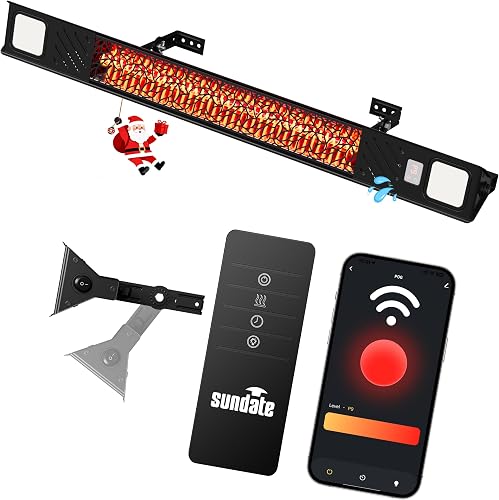
Sundate Wall-Mount Patio Heater with Light
Best for changing warmth preferences - 5
 Check it
Danluke 1500W Hanging Infrared Heater
Best for simple patio routines
How we chose these covered patio heaters
We chose electric infrared models that keep the floor clear and suit different seating layouts. Mounting position, heat adjustment and everyday controls matter more here than a long feature list.
All 5 reach the same maximum power, so the choice centers on where you can install them and how you want to use them. More heat levels provide finer adjustment, not a higher maximum output.
The picks cover wall mounting, overhead placement, remote operation and simple pull-cord control. None should be treated as a promise to warm an entire patio, since wind, distance and layout affect comfort.
Weather protection is a separate consideration from heat clearance. A water-resistance rating doesn't tell you how close a heater can sit to a roof, curtain or wooden beam.
| Product | Best for | Power | Mount | Controls | Our score |
|---|---|---|---|---|---|
| Hykolity 1500W Wall-Mount Infrared Patio Heater | everyday patio seating | 1500W | Wall mount | 3 levels, remote, 0 to 24-hour timer | 8.4 |
| Sundate Ceiling Hanging Infrared Heater | shared patio controls | 1500W | Ceiling mount | 9 levels, WiFi, remote and touch panel | 7.4 |
| Pasapair 1500W Hanging Carbon Infrared Heater | evening patio dining | 1000W or 1500W | Ceiling mount with included chain | 6.9 | |
| Sundate Wall-Mount Patio Heater with Light | changing warmth preferences | 1500W | Wall mount | 9 levels, WiFi and remote | 6.9 |
| Danluke 1500W Hanging Infrared Heater | simple patio routines | 1500W | Ceiling mount | 6.6 |
The best outdoor heaters for a covered patio
The Hykolity is the strongest starting point for a fixed seating area beside a wall. The hanging models make more sense when overhead support offers a better path to the people you want to warm.
Hykolity 1500W Wall-Mount Infrared Patio Heater
- 1500W infrared heat
- Wall mount
- 3 power levels
- Remote and timer up to 24 hours
A practical choice for a regular seating area beside a suitable wall. Three heat settings give you useful adjustment without a long menu of controls.
Pros
- Three power levels
- Remote control and timer
- IP55 water and dust protection
Cons
- Needs a suitable wall near seating
- No WiFi control specified
Choose the Hykolity for a regular patio seating area where you want useful adjustment without many controls. Its 3 power levels, remote and 0 to 24-hour timer cover the main tasks: starting heat, reducing it and setting a shutoff time.
The aluminum housing has IP55 protection against dust and water ingress within that rating's limits. That makes weather protection part of its appeal, while the manual still determines permitted exposure and installation.
A wall position can work well beside a sofa or a pair of chairs that usually stay in place. Before ordering, sit in those seats and check whether the proposed heater position faces them without a post, screen or tall chair back blocking the path.
Skip this model if the available wall is far from your seating or points across an unused part of the patio. A ceiling model above the gathering area could be a better fit, even though it ranks lower overall.
It also isn't the first choice for someone who specifically wants app control. Its appeal is a manageable set of controls for a familiar, fixed layout.
Sundate Ceiling Hanging Infrared Heater
- 1500W infrared heat
- Ceiling mount
- 9 heat levels
- WiFi, remote and touch controls
Multiple control methods suit a patio used by several people with different preferences. Confirm the ceiling installation method before choosing its mounting position.
Pros
- WiFi, remote and touch controls
- 9 heat levels
- 24-hour timer
Cons
- Requires suitable overhead support
- More controls than basic users need
Choose the Sundate ceiling heater when several people want different ways to control the heat. WiFi, remote and touch controls let you choose the method that suits your routine, with 9 heat levels for smaller adjustments.
That flexibility helps when one person uses a phone while others prefer a physical remote. Its 24-hour timer adds a shutoff option for planned patio sessions.
Overhead placement is the main reason to consider it over a wall heater. It can suit a seating zone away from the house wall, provided the mounting arrangement directs heat toward that zone and meets every clearance.
Sundate uses both ceiling and wall language for this model, so confirm the installation method for the exact unit before arranging support. Don't assume a bracket can be turned or adapted to suit a different surface.
Skip it if you want the fewest possible steps between sitting down and feeling warm. The extra controls are useful only if you'll use them, and they don't solve a poor mounting position.
Pasapair 1500W Hanging Carbon Infrared Heater
- 1000W and 1500W settings
- Ceiling mount
- Remote control
- IP24 splash resistance
Two heat settings suit a fixed dining area where guests stay seated. Pasapair describes the heating tube as lower glare, and the included chain supports overhead installation.
Pros
- Two heat settings
- Remote with holder and lanyard
- Child lock and overheat protection
Cons
- Heating glow does not replace patio lighting
- Splash resistance does not permit unrestricted exposure
The Pasapair is the best fit here for evening meals beneath a suitable hanging point. It offers 1000W and 1500W settings, and Pasapair describes its carbon tube as giving off softer, lower-glare light.
That makes it worth considering when a bright heating glow would distract from dinner. Expect a red-orange heating glow, though, and keep separate lighting for food, steps and walkways.
An included chain supports hanging installation, while the remote lets you change heat from your chair. The remote holder and lanyard give you a practical way to keep the control near the dining area.
Its IP24 construction provides splash resistance, and it includes a protective guard, child lock and overheat protection. These features support careful use but don't make the hot heater safe to touch or allow it to sit close to fabric.
Skip it if wind-driven rain regularly reaches the planned location beyond the exposure its manual permits. Also choose another option if you need finer heat adjustment than two settings provide.
Sundate Wall-Mount Patio Heater with Light
- 1500W infrared heat
- Wall mount
- 9 heat levels
- WiFi and remote controls
A wall-mounted option for people who want more steps between low and full heat. WiFi control and two included remotes offer several ways to make adjustments.
Pros
- 9 heat levels
- WiFi and two remote controls
- Overheat protection
Cons
- Needs a suitable wall facing seating
- IP34 protection has exposure limits
Choose this Sundate wall model if you frequently want a small change in warmth rather than a large jump between settings. Its 9 heat levels give you more adjustment steps, with WiFi operation and two included remotes.
The extra remote is useful for keeping a control in a regular place while retaining a spare. Store both somewhere dry and accessible instead of leaving them loose on an outdoor table.
Included wall brackets support installation, and the heater has IP34 protection plus an overheat cutoff. Check the required wall surface and bracket position before deciding where furniture should go.
This is the alternative to Hykolity for buyers who place more value on app access and finer adjustment. Neither feature increases its maximum heat output, so choose based on control preference and mounting fit.
Skip it if the only available wall faces away from the gathering area. Also avoid choosing it mainly for lighting: the supplied details don't establish light output or the area it can illuminate.
Danluke 1500W Hanging Infrared Heater
- 1500W infrared heat
- Ceiling mount
- Carbon fiber heating element
- Pull-cord on and off
A straightforward choice for people who want to switch overhead heat on and off with a cord. Its single setting suits users who do not need heat adjustment.
Pros
- Keeps floor space open
- Simple pull-cord control
- Focused radiant warmth
Cons
- No lower heat setting
- Pull cord needs an accessible position
Choose the Danluke for a simple switch-on, switch-off routine beneath a suitable ceiling mounting point. Its pull cord controls a single 1500W setting, so there are no heat menus or remotes to keep track of.
That arrangement suits someone who uses the same chair or small gathering zone and wants heat only during cool periods. The overhead design also leaves the floor available for chairs and walking space.
The fixed output is its clearest limitation. If you often feel too warm after a few minutes, you'll need to turn it off rather than select a gentler setting.
Plan the pull-cord position before mounting. You should be able to use it from a stable standing position without leaning over a table, reaching toward hot parts or climbing onto furniture.
Skip this model if different guests regularly ask for different heat levels. It also isn't a good match for a high installation where the cord cannot remain accessible within the approved setup.
How do you choose an outdoor heater for covered patio seating?
Choose by mounting fit, seating position and power access, in that order. Controls become useful once those three basics work.
Match your covered patio heater to one occupied zone
Start with the place where people spend the most time. A dining table, reading chair or compact sofa group is a clearer target than the full square footage beneath the roof.
Draw a simple plan showing chairs, posts, walls and the proposed heater position. Include where people actually sit, since the center of a table and the center of the occupied seating area aren't always the same point.
If you host large groups across separate areas, don't expect one heater to serve every seat equally. Plan around the main gathering zone first, then assess whether another approved heating position and suitable electrical capacity are available.
Choose the mounting position before the control features
A wall heater suits seating near a usable vertical surface. A hanging heater suits a fixed gathering area beneath a structural point that can support the approved installation.
Wall mounting also leaves overhead space available for existing fixtures. Hanging placement can help when the patio's walls are mostly doors or windows, but it may conflict with a fan, pendant light or low beam.
Use our guide to wall-mounted patio heaters if your layout points toward that format. Compare the permitted mounting positions before deciding which controls you prefer.
Pay for adjustment you'll actually use
Choose several heat levels if your patio use spans mild evenings and colder nights. Smaller steps also help when guests have different comfort preferences.
A basic on/off model suits shorter sessions where full heat feels appropriate. A remote is especially useful above a dining table, while an app matters most if phone control already fits your routine.
Timers help limit forgotten operating time, but they don't replace switching the heater off when you leave. Set a duration that matches the visit rather than the longest time available.
What should you check before mounting a patio heater?
Check clearances, structural support and the electrical supply before drilling any holes. A roof that keeps rain off your chairs doesn't automatically provide a suitable heater location.
How do you check outdoor heater clearance for a covered patio?
Use the exact distances in the chosen model's manual. Measure above, beside, behind and below the unit wherever the instructions require space.
Account for moving objects too. Curtains can blow toward a heater, doors can swing beneath it, and a patio umbrella may rise into a space that looked clear during planning.
Check whether the heater's permitted angle changes its clearance needs. Don't tilt or reposition the unit beyond the allowed range to reach a cold chair.
Does the patio cover material matter?
Yes, both the cover and nearby finishes affect placement. Wood, fabric, plastic panels and other heat-sensitive materials need the clearances required by the heater and cover manufacturers.
A metal bracket attached to wood doesn't make the surrounding structure noncombustible. Likewise, adding your own heat shield doesn't authorize a smaller gap unless the relevant instructions expressly allow that arrangement.
If either set of instructions rules out the location, choose a different position. A heater that cannot fit with all required space around it is the wrong model for that spot.
Can the structure support the installation?
Mount only to a surface or support suitable for the heater and its approved hardware. Thin roof panels, decorative trim and gutters should not be assumed to carry a hanging load.
Included screws, anchors or chains don't fit every building material. Have a qualified installer resolve uncertain support, fasteners or access rather than improvising a connection.
Check the power-cord route at the same time. It must reach safely without pulling on the heater or running across a walking path.
Will one infrared heater warm the whole patio?
Plan for focused comfort around seating, not an evenly heated outdoor room. Infrared warmth depends on the path from the heater to people and nearby surfaces.
A roof can shelter the area, but open sides still allow cold air and wind through. Radiant heat helps warm people directly, while moving air can continue to make them feel cold.
Distance and obstructions matter. A heater mounted where it meets clearances may still be too far from a particular chair to provide the comfort you want.
Avoid selecting a unit solely from a claimed coverage area. Your layout, exposure and permitted mounting distance are more useful planning tools than a single square-foot figure.
For more help matching heat to your seating zone, use our patio heater size guide. Our explanation of how a patio heater works also covers why heat direction matters.
What electrical setup does a covered patio heater need?
These heaters need a suitable outlet and enough available circuit capacity. Check the exact voltage, current and connection requirements in your chosen model's manual before planning installation.
A high-output heater can use much of a household circuit's available capacity. Other outlets on the same circuit may serve lights, appliances or equipment inside the house.
Don't assume two nearby outlets are on separate circuits. If you're planning multiple heaters or don't know what shares the supply, have an electrician assess the load.
Use an outdoor electrical arrangement with the protection required for the location, including GFCI protection where applicable. Keep plugs and connections away from standing water and avoid routing cords through places where doors can pinch them.
Follow the heater's instructions on extension cords, power strips and external controls. Don't add a smart plug or adapter unless both devices permit the heater's load and the outdoor installation.
For budgeting, our guide to electric patio heater running costs explains how power, operating time and your electricity rate affect use. Lower settings and shorter sessions can reduce energy use when they still provide enough warmth.
How should you set up and use the heater?
Install it with the seating layout already planned, then check how that arrangement works during normal use. Moving furniture after installation can put people outside the warm zone or bring objects too close.
Before first use, remove packaging and inspect the housing, cord and mounting parts. Follow the manual's startup steps and keep the required space clear.
Begin with an appropriate heat setting and adjust from your seat if the model allows it. Don't compensate for poor placement by pushing furniture inside the minimum clearance.
Keep cushions, blankets, decorations and hanging plants away from hot parts. A guard or child lock doesn't remove the need to supervise children and pets near the heater.
Switch the unit off when leaving the patio and let it cool before cleaning or making permitted adjustments. App access and a timer should support that routine, not replace it.
How do you care for a heater beneath a patio cover?
Keep the heater clean, dry within its permitted exposure limits and securely mounted. Covered installations can still collect dust, insects and moisture.
With the unit off, disconnected as instructed and fully cool, clean it using the method in its manual. Avoid directing a hose or pressure washer at the housing, heating tube or electrical connections.
Periodically inspect accessible brackets, chains and fasteners for looseness or corrosion. Stop using the heater if its cord is damaged, its support shifts or it behaves abnormally.
After storms or a long period without use, check for debris and changes around the heater. New curtains, stored cushions or climbing plants can reduce clearance without anyone moving the unit itself.
Use a protective cover only if suitable for the heater, and fit it after the unit has cooled. Remove it completely before operation, and follow the manual's storage guidance during extended breaks.
Which mistakes make a covered patio heater a poor buy?
The biggest mistakes are choosing before measuring and expecting controls to overcome poor placement. Resolve the physical fit first.
- Buying for the whole roof area: Target occupied seating instead of empty corners and walkways.
- Choosing the highest mounting point: Greater distance can weaken the comfort you feel, while minimum and maximum mounting limits still apply.
- Treating water resistance as heat clearance: These describe different limits and cannot substitute for one another.
- Closing the sides to hold warmth: Curtains and screens change the space and can introduce new clearance or ventilation concerns.
- Adding heaters without checking the circuit: A second unit needs electrical planning as well as another mounting point.
- Relying on automatic protection: A cutoff is a backup feature, not permission to block the heater or leave it running unattended.
If the only workable location requires improvised mounting or an unsafe cord route, pause the purchase. Solving the location or supply problem first is more useful than buying a heater you cannot install correctly.
Which outdoor heater should you choose for a covered patio?
Choose Hykolity for a fixed seating area beside a suitable wall. Choose the Sundate ceiling model if overhead placement fits better and several control methods will be useful.
Pick Pasapair for evening dining where a lower-glare heating glow matters. Choose the Sundate wall model for finer heat adjustment, or Danluke if a simple pull cord and fixed output match your routine.
Before ordering an outdoor heater for covered patio use, confirm the mounting support, all clearances and the electrical connection. If any of those fail, choose another location or model.
For the final placement checks, read can you use a patio heater under a covered patio?.
Our top 3 picks at a glance
-
1
Best for everyday patio seating
Hykolity 1500W Wall-Mount Infrared Patio Heater
8.4/10 our score
See it on Amazon -
2
Best for shared patio controls
Sundate Ceiling Hanging Infrared Heater
7.4/10 our score
See it on Amazon -
3
Best for evening patio dining
Pasapair 1500W Hanging Carbon Infrared Heater
6.9/10 our score
See it on Amazon
Frequently asked questions
Can you use an outdoor heater under a covered patio?
Yes, some outdoor electric heaters suit covered patios when their manuals permit the location and every clearance can be met. Check the roof material, mounting support, power supply and exposure to rain before installation.
Weather protection alone does not establish whether a heater can safely sit beneath your particular patio cover.
How much clearance does a patio heater need under a ceiling?
Use the exact distances in your heater's manual, since ceiling and side clearances vary by model and mounting arrangement. Measure from the specified points on the heater, including any required space above it.
Check nearby beams, fans, curtains and furniture too, and follow any restrictions from the patio-cover manufacturer.
Is an electric or propane heater better for a covered patio?
Electric heat is a practical starting point for covered seating because it needs no fuel cylinder and creates no combustion exhaust at the heater. It still needs approved placement, suitable power and clear space.
Propane adds ventilation and fuel-storage requirements, explained in our propane versus electric patio heater guide.
Can you use a propane patio heater under a covered patio?
Only use one there if its instructions allow the location and all ventilation and clearance requirements are met. Open sides do not automatically make every covered patio suitable, and outdoor propane heaters must never operate in enclosed spaces.
Read our guide to using a patio heater under a covered patio before choosing.